Showing posts with label Texas. Show all posts
Showing posts with label Texas. Show all posts
Wednesday, January 21, 2015
Boyhood (2014)


Wednesday, July 03, 2013
Me and Bobby Mcgee - Some Background
Some interesting facts about this song that I just learned:
- Kristofferson was influenced by Fellini's La Strada.
- The impetus for the song was a writing assignment given to Kristofferson by his new song publisher, Fred Foster, when Kris said he was having a dry spell. Foster told him to write something with an "On the Road" concept about me and Bobby McKee, a secretary at the publishing company.
- At the time, Kris was flying oil workers out to rigs in the Gulf of Mexico via helicopter during the week, then flying back to Nashville on the weekends to work on his musical career. The song basically came while he was flying around Baton Rouge and New Orleans.
From the new book, Outlaw: Waylon, Willie, Kris and the Renegades of Nashville. Tanks to Paul Wiener for letting me know about it.
Saturday, June 08, 2013
Willie Nelson Concert
Oh that any of us are still as creative, energetic and fun at 80 years old as Willie Nelson. We really, really enjoyed his concert last night.
Whatever fears I had of seeing some sad old-timer playing beyond his years were immediately dispelled by the rousing opening version of “Whiskey River” and a swinging “Still Is Still Moving to Me.” The guy is truly amazing. His voice sounded great (better than on one of his recent albums) and his always underrated guitar playing was terrific: warm and beautiful at times, as on Django Reinhardt's "Nuages", or hard-driving and almost atonal on “Night Life.” What many people fail to realize is that beneath Willie Nelson the cartoon-figure cultural icon there percolates a musical mind of the highest order. His understanding of jazz, popular music, country, rock, folk, Mexican and Latin music and other genres is tremendous. As someone who loves all kinds of music, I find it invigorating. Tell me what living performer in a 90-minute show could weave together in a seamless whole Django, Irving Berlin, Hoagy Carmichael, Hank Williams, Bob Wills, Carl Perkins, Kris Kristofferson, shit-kicking country, gospel hymns, rockabilly, two songs originally performed with Snoop Dog, and, of course, the tremendous Willie Nelson catalog? His moody, samba-country arrangement of Berlin’s “Let’s Face the Music and Dance” may have been the highlight of the evening. (Even better than the studio version attached.) I don’t think I had ever really paid attention to Berlin’s opening line, “There may trouble ahead,” but last night when Willie growled out the words, I had images of outlaws riding into Mexico floating through my head, and the darker atmosphere of the song really came out.
The musicianship last night was top notch. In addition to Willie, the line-up included the key members of the classic “Family” line-up that produced all of those great outlaw country records in the early and mid-70s: his sister Bobbie on piano, Paul (The Devil) English on drums and percussion, and Mickey Raphael, who may now be the greatest living harmonica player, with all due respect to Toots Thielemans at 91. These people have been playing together off and on for about 40 years (Willie and English actually first played together in 1955!), and they know each other so well, that they can follow one another with great skill and ease from a hell-raising country song to a haunting version of "Gerogia." But the key to everything may be the young stud on stand-up bass whose super groovy, driving rhythm kept the old folks on their toes. I don’t know the guy’s name, but he made his presence felt from the first moment of the night. There was also a young drummer/percussionist who switched off and on with English, who suffered a minor stroke in 2010. The Devil would play drums on some of the old hits and more mellow pieces, and the young drummer took over on the swinging, upbeat songs. When not on drums, they both added some terrific percussion, especially English. He may not be able to pound the skins on every tune any more, but he’s a wise old dog with a great ability to add the perfect spice to a song - a chilling set of chimes during “Georgia,” or tasteful maracas during one of the Mexican-flavored works.
The other thing that impressed me was that many of the best songs of the evening were from Willie’s last two albums, Let’s Face the Music and Dance (2013) and Heroes (2012). He certainly played some of his classics (including my two favorites – “Me and Paul” and “Funny How time Slips Away”) and his big hits, which had the crowd singing along, but in no way was this some kind of retrospective show. He’s still making good music and having fun performing it live. Another great part of last night was hearing this group play some of those awful, syrupy Willie songs from the early 80s ("Always on My Mind" "To All the Girls I've Loved") that I've always hated. Suddenly, with new stripped-down arrangements, they didn't sound half bad. Also, thinking back on it, I can't believe how much material the guy crammed into 90 minutes. They never took a break, and he (sadly) didn't chatter much between songs. They just played. And played a lot.
In the end, the best part of the night may have just been watching an 80 year old musical artist with so much joie de vivre, who obviously still loves what he’s doing, does it pretty damn well, and seems to really enjoy playing for people. And they enjoy him. There was a great communal spirit in the auditorium last night. And my oh my how the ladies do love this old fart. At one point, Alexandra and I thought we were at a Tom Jones concert, as not one, not two, but three women climbed on stage to give the guy a kiss or throw him a bandana or try to hug him. And one of them was probably in her 20s or 30s! Yes, Willie sing-talks through some of his songs, but he did it wisely and to good effect, turning a potential weakness into a strength. And I’m sure his guitar skills are not the same at 80 as they were at 40. But all in all, the guy was pretty impressive. My only regret last night was that I hadn’t gone to see Willie sooner in my life, so I could have experienced him more in concert. If we could, we would go again this evening. Alexandra and I both really enjoyed ourselves.
Thursday, January 29, 2009
thought dream 012709.2
O colossal cobra, demon of my mind,
rising up on reptilian muscle
from the core, the woven
wicker basket of the soul,
where you lay curled in darkness,
waiting for some mysterious
music to call you forth.
You're from the wrong culture.
It's the rattlesnake I fear.
Serpent of the Texas landscape,
hiding in crags of limestone in
rock shelves down by the river,
me rising out of the water
on a hot summer day, trying
to pull myself up on a ledge
in the August sun, hand
reaching out for something
to hold onto, you waiting
in the cool shadows. Always
waiting. Will I ever hear
your rattle before you strike?
God, I hate snakes.
Sunday, November 09, 2008
The Noble Campaign
 This morning on Meet the Press, Jon Meacham, Editor of Newsweek, said that John McCain had run "a noble campaign."
I was - how shall I say? - a little surprised by the comment.
"And we should mark that," he continued. "It could've been a lot worse."
Meacham's got a point. The McCain campaign tried to portray Obama as Un-American, Un-Patriotic, an Appeaser, a Marxist, a Socialist, a Muslim, a Terrorist, etc.
They didn't quite get to Pedophile, Serial Killer, or Drug Lord. (Though several surrogates, including Rudy Giuliani, did hint at Obama as a possible drug dealer.)
And it wasn't outside groups making the accusations this time, as with the Swift Boaters in 2004. It was the McCain campaign itself.
But Meacham's not the only normally reasonable person pushing the "McCain ran a noble campaign" meme. I've seen two other Liberal or centrist pundits jump on the bandwagon this week. And, sadly, in all three cases, neither the host nor any of the other guests ever bothered to question this assertion or ask for more explanantion.
Just before the election, Mark Shields, the "Liberal" commentator on the The Newshour with Jim Lehrer, said, "The most admirable thing John McCain did was not to play the race card in this campaign. And for that, he should be -- he deserves some credit."
So, Mr. Shields, was it just some good-natured joshing of Barack Obama and his policies that led to the toxic atmosphere at those Sarah Palin rallies? This week, the U.S. Secret Service revealed that Palin's rallies "provoked a spike in death threats against the future president."
The Secret Service warned the Obama family in mid October that they had seen a dramatic increase in the number of threats against the Democratic candidate, coinciding with Mrs Palin's attacks.Congressman John Lewis, who was almost beaten to death by racists when he was a Freedom Rider in 1961, said that McCain and Palin were "sowing the seeds of hatred and division" and "hostility in our political discourse," and mentioned the hateful tone of George Wallace back in the 1960s.Michelle Obama, the future First Lady, was so upset that she turned to her friend and campaign adviser Valerie Jarrett and said: "Why would they try to make people hate us?"
And Stratfor, private intelligence analysts, issued a report this week on security threats against Obama by white supremacists: "Two plots to assassinate Obama were broken up during the campaign season, and several more remain under investigation. . . . We would expect federal authorities to uncover many more plots to attack the president that have been hatched by white supremacist ideologues."
"Muslim," for one, was always the race card. I still don't believe that 23% of the people in Texas really thought Obama was a Muslim. That's just the terminology they used in public instead of calling him a Dirty N-$#$%&%$.
And there were numerous openly racist remarks and brochures sent out by McCain campaigners at the local level.
 My guess is that Meacham and Shields and other commentators are praising McCain for not bringing up Rev. Jeremiah Wright in the campaign. Somehow, this made McCain "noble" and proved he didn't play the race card. What else could it be?
Ironically, I think Rev. Wright would've been more of a legitimate issue to bring up than William Ayers, or Obama being a Marxist. The latter two issues simply didn't have any substance behind them. There were still a few pockets of doubt about Wright, however, despite Obama's powerful and moving speech on racism in Philadelphia when the issue came up during the primaries. Did Barack ever fully explain why he stayed in the church as long as he did, or which part of Wright's belief system he shared? I don't think Wright would have been a very effective or worthwhile topic for the McCain campaign to raise, but I don't think it would've been racist to ask some questions.
So, did McCain run a "noble campaign" in the end?
I offer a story. . .
My aunt, an Obama supporter, lives in Odessa, Texas, heart of George W. Bush country, and a place where I'm sure that more than 23% of the people said they thought Obama was a "Muslim." A nurse comes to my aunt's house every few days to check on her. During the campaign, she showed up wearing a McCain button. Nothing surprising about that in Odessa, Texas.
When the nurse came to visit a couple of days after the election, my aunt asked her if she had voted. "Yes," she said, "Mother and I went down and waited for a long time and we finally got in. We voted for all the local races, but we didn't vote for president."
Surprised, my aunt asked her why.
"Well, we were getting all those emails about Obama, saying he was a Muslim and a Marxist and everything. . . . But I just didn't think he was.
Mother and I would see those people on TV . . . and we just didn't think we were like them. We don't want to be like them."
Wednesday, October 08, 2008
Are You Sure Hank Done It This Way?
 February 1959. Buddy Holly and the Crickets are touring with Ritchie Valens and the Big Bopper. Holly hires a four-seat airplane to take his band to Fargo, North Dakota. The Big Bopper has a cold, so one of the Crickets, Waylon Jennings, offers him his seat on the plane. A few minutes later, Holly, Valens and the Big Bopper would be dead, the plane crashing in snow shortly after take-off.
In 1965, after struggling a few years with grief and guilt, Jennings headed to Nashville, where he eventually made it as a country singer. But he grew increasingly frustrated with the stuffy attitudes and limited artistic freedom in Music City USA. Along with another rebellious Texan named Willie Nelson, he rejected the "rhinestone suits and new shiny cars" of the slick Nashville scene and began experimenting with a new sound.
By the early 1970s, Jennings and Nelson had started blending a rock and roll sensibility with the country tradition of Hank Williams, Bob Wills and Johnny Cash.  It was an edgier form of country, musically stripped down and lyrically more complex, and it became known as "progressive country" or the Outlaw movement. One of the influences on the new sound was Johnny Cash's own friendship and musical exploration with Bob Dylan in the late 1960s. Dylan wrote "Wanted Man" for Cash, who included it on his 1969 live album, At San Quentin. (Real outlaw music.) And, of course, Dylan himself was greatly inspired by Hank Williams. So, it shouldn't have been a surprise when Dylan went country. Or when country went Dylan.
Or when one of Buddy Holly's Crickets dug back into his rock and roll roots to lament what Nashville had become.
Here's Waylon in 1975, singing what became a kind of anthem for the outlaw country movement: "Are You Sure Hank Done It This Way?"
Lord, it's the same old tune, fiddle and guitar
Where do we take it from here?
Rhinestone suits and new shiny cars
It's been the same way for years
We need to change
Somebody told me when I came to Nashville
Son, you finally got it made
Old Hank made it here; we’re all sure that you will
But I don't think Hank done it this way
I don't think Hank done it this way
Ten years on the road, making one night stands
Speeding my young life away
Tell me one more time just so I'll understand
Are you sure Hank done it this way?
Did Ol' Hank really do it this way?
Lord, I've seen the world with a five piece band
Looking at the back side of me
Singing my songs and one of his now and then
But I don't think Hank done 'em this a'way
I don't think Hank done 'em this a'way
Sunday, June 01, 2008
Funny How Time Slips Away
 Feeling nostalgia for my youth in Austin . . . .
Here's Willie Nelson singing his beautiful song "Funny How Time Slips Away" at his 2nd Annual Fourth of July Picnic, 1974.
(With a very drunk Leon Russell. From what I've heard and read, there was a wee bit of drinking and toking at those 4th of July Picnics.)
To see just how time slips away, check out Willie singing the same song in the 1960s. It's the second one in the medley.
Al Green does a nice version of the song here.
Elvis Presley, The Supremes and Dave Matthews also do versions.
Monday, May 05, 2008
¡Feliz Cinco de Mayo!
Doesn't get much more Tex-Mex than this. . . .
Freddy Fender, Flaco Jiménez and a special guest sing the classic, "Volver, Volver."
Monday, February 11, 2008
Texas Two Step
 It's not easy trying to figure out Texas' complicated primary/caucus/thing-a-majig that's going to be held on March 4. Or how it might affect the Democratic race.
Mary Mapes, sounding at times like Molly Ivins or Ann Richards, has an excellent and fun introduction in "Texas Time," at Huffington Post. It's worth reading the whole thing. Here's a Texas-size pecan chew of an excerpt.
[I]n a campaign where voters are already defying some of the old demographic breakdowns, Texas promises to give the pundits and campaign planners a run for their money, beginning with the most basic characterizations.Marc Ambider has some interesting thoughts in "Texas's Unique Primaucus," from his blog on The Atlantic web site.Texas is not the South. It is not the West. It is not the Southwest.
Texas is all those things, a heady blend of magnolia blossoms and masa harina; a place big enough and complicated enough to treasure both the Alamo and the dreams of millions whose lives began in Mexico. It has memorials to Civil War heroes and civil rights legends, border towns without running water and the latest thing from Barney's.
Texas is home to both big oil and big hair; sometimes to big, oily hair.
It is a warm, fun-loving, forgiving state, the kind of place where the vice-president can shoot someone in the face and the victim apologizes.
Clearly, it isn't easy to embarrass Texas. But it appears George W. Bush has finally done it. In a stark change from the public's attitude here a few years ago, now there are bumper stickers on family cars in grocery store parking lots that proclaim "Bush wasn't born here" and "George W. Bush is a failure."The rest of the country may figuratively turn disgraced politicians into piñatas, but in Texas, the transformation is literal. In fact, a party store in Austin will custom-make a George W. Bush piñata for you for only 23 dollars. Don't ask how I know this.
The Democratic race is going to be more complicated and more unpredictable because both candidates have huge built-in constituencies, good organizations and giddy support. Texas Democrats are almost hysterical at the heart-pounding possibility that the rest of the country will at long last pay attention to what they think. In addition to all that, no one knows how the hell the delegate count is actually going to work.In typical Texas contrarian fashion, the primary rules read like a DNA chart. On the Democratic side, 228 delegates are up for grabs. But it's not that simple.
The state has both a primary and a caucus -- on the same day. And you can't caucus unless you voted in the primary. On primary night, 126 delegates will be determined based on voting results in each Senate district.
The number of delegates in each district is based on how many Democrats voted in the last two general elections in that district. Got that? Well, there's more.
The selection of another 67 delegates will begin at the caucuses that night and culminate at the state convention in June. The remaining 35 delegates are some kind of unique political life form that will evolve into actual delegates at the National Convention later that summer.
With rules like this, we may not know the division of Texas delegates until sometime after the new President is sworn in. Now that the state finally has its moment in the spotlight, it appears we will slowly drag our rear ends across the stage and reveal our delegate counts only when we are good and ready.
The candidates are already familiar faces. Barack Obama has been here raising money and making friends since long before he announced his candidacy. Hillary Clinton actually lived in Austin in 1972 while working for George McGovern. She knows the state and has racked up an impressive series of endorsements.
Hillary seems to be ahead in early polling. Texans, despite the state's conservative reputation, have never had any discomfort with women taking the reins. Texas women have been changing the world for a long time.
That creates a special challenge for Hillary Clinton.
Down here, she will have to live with the ghosts of Barbara Jordan, Ann Richards, Molly Ivins and Lady Bird Johnson. She will have to prove to voters that she has more in common with these iconic Texas political figures than with Ma Ferguson, the state's first female governor. Ferguson took over in 1925, several years after her husband was run out of office.
Actually, Hillary Clinton is nothing like Ma Ferguson. They have nothing but body parts in common. Still, by making that comparison, I get the chance to use a hilarious quote attributed to Ferguson during a debate on the use of Spanish in Texas public schools. She exhorted the state to require English, saying, "If English was good enough for Jesus Christ, then it is good enough for the children of Texas."
Which brings up another point. Texans expect candidates to be entertaining. They can be funny like Ann Richards, a charming rogue like Charlie Wilson, or personable like George W. Bush used to be.
Obama has that -- and something more. For Texans old enough to remember, he recalls Barbara Jordan -- not because of race, but because of the power of the spoken word. Decades ago in her campaigns for Congress, in small towns and large cities, in front of crowds who gathered at courthouses and on street corners, she became a political legend by reminding people of why they loved their country. She led old men in sweat-stained cowboy hats to weep openly at the beauty of the Constitution, the power of the American people, the depth of our belief in our own inherent decency.
Texans are still like that. They still like good speeches. They still like to cry in public. And they will always love politics.
To win in Texas, Democrat or Republican, there is really only one rule. Don't be dull. We certainly won't.
The delegate-rich districts are the most heavily liberal state senate districts. According to this calculation, they're in Austin and in two of the most concentrated African American parts of the state. Advantage: Obama.
Clinton will get plenty of support from Latino voters, but they tend to be more spread out and thus will see their votes somewhat diluted in the 31 separate primaries. In order to "win" -- both enough delegates and statewide, you need to organize what amounts to caucus-like campaigns in each of these districts.
The white vote in Texas will probably split, with Obama taking men and Clinton taking women. Though Latinos make up a slightly larger share of the electorate than African Americans, they tend to vote in lower proportions.
Suffice it to say: whatever you call Texas's system -- a hybrid, a primacaucus, whatever -- do not assume that, because it's a big state and the media calls it a primary, the math favors Hillary Clinton.
 Y'all Come Back Now!
Tuesday, November 20, 2007
News You Can Use
 Good news for New Jersey squirrel eaters
NEW YORK (AFP) - Squirrel eaters in the US state of New Jersey have been told that the bushy-tailed rodents are likely safe to eat, after earlier being advised the unlikely delicacies could contain toxic metals. The Environmental Protection Agency said earlier this year it had discovered high levels of lead in a squirrel taken from near a waste dump in the Ringwood area and advised people to eat the rodents no more than twice a week.Good table fare . . . Well, hell, I could've told you that. Any self-respecting Texan has eaten squirrel at least once in his or her life. My great aunt Era cooked up a pretty good squirrel. (Though nothing beat her homemade chicken and dumplings, the likes of which I'll never encounter again.)
Officials have now said the test results were an error.
"A blender that was used to process the tissues into usable samples was defective and was identified as the source of the lead contamination," the Environmental Protection Agency said in a statement dated Monday.
The New Jersey Division of Fish and Wildlife describes squirrel as "good table fare," offering recipes for squirrel chowder, stew and barbecue.
Unfortunately, the article DID NOT GIVE A LINK to the NJ Division of Fish and Wildlife Squirrel recipes. (See, I've done the work for you.) That will take you to "Late Season Squirrel Hunting in New Jersey," By Jon Kline, Natural Resource Interpretation Technician for the NJDF&W. Before giving recipes, Jon offers this advice:
Hunters who ignore late-season squirrels are missing a great hunting opportunity. Squirrel populations are thriving and abundant in the Garden State. . . .Okay, two things here. First, The New Jersey Division of Fish and Wildlife must be facing some real budget problems, because they haven't updated their squirrel recipes in about five years. So that craving you have for wasabi-encrusted squirrel - you're on your own.
Shotgun season for squirrels in New Jersey runs to February 17, 2003.
Secondly, come on . . . a shotgun for squirrel? Yeah, I know some people do it, but real squirrel hunters use a .22. The Connecticut Outdoorsman website backs me up on this in their section on Connecticut Squirrel Hunting:
For starters, have you ever eaten a shotgun-killed squirrel? Pellets can be a pain to keep removing and there is no need to damage more meat than need be.Amen, brother. Same goes for rabbit and quail. You start with a limited supply of meat to begin with - why mess it up with pellet? I remember one restaurant in Spain that didn't even bother taking the pellets out. I almost broke my teeth trying to get through a fried . . . well, some small dead thing.
Second, a shotgun blast will alert the whole woods to your presence. Though a .22 can sound loud in the quiet woods, the effects will not be nearly as serious. I've shot many consecutive squirrels with a .22, but getting more than one at a time with a shotgun is rare.There's nothing more traumatizing to a young sportsman than crippling a small, innocent animal instead of landing a good, clean head-shot. Believe me, I know. My career as a hunter pretty much ended on a rare hunting trip with my father out in West Texas. I shot a rabbit but only managed to wound him (or, probably her - a mother, no doubt). All we discovered was a bloody trail disappearing into the tumbleweeds. I was so upset, I haven't shot at an animal since.
Third, a long shot with a shotgun can cripple better than kill. A well placed .22 bullet will rarely fail in its mission.
But I'm getting off track. The New Jersey squirrel recipes weren't bad, especially the one for squirrel chowder - we don't do much squirrel chowder in Texas - but I offer some alternative recipes from Texas A&M University.
Now, many people from Austin who are alums of the University of Texas (Hook 'em Horns!) might make fun of A&M, but I've never had anything but the utmost respect and admiration for the Aggies. (By the way, did you hear the one about the Aggie who locked his keys in the car? He called up the locksmith in a panic and said, "You've gotta help me! I've locked my keys in the car, and my family's trapped inside and can't get out!") It's true that their football team plays like girls and their overall level of intelligence can be counted on one finger, but if you want real Texas squirrel recipes from a scholarly (cough) institution, I can't think of a better source:
SQUIRREL
Squirrel is one of the most tender of all wild game meats. The rosy pink to red flesh of young squirrel is tender and has a pleasing flavor. The flesh of older animals is darker red in color and may require marinating or long cooking for tenderness.
PREPARING FRIED SQUIRREL
After cleaning, cut up for frying, soak overnight in salt water. Before frying (like chicken exactly) put squirrel in cooker oven with water and "par boil" until meat is tender when stuck with fork. Don't cook until meat falls off bones - as you want to batter it with flour to fry (not too fast) like chicken. Season with salt and black pepper to taste.
Rinse skinned squirrel in cold water and pat dry, dip in buttermilk and then in seasoned flour and fry in hot fat just as you would a chicken.
If the squirrel is young, you probably will not need to steam the meat. If there is any doubt, drain off excess fat in the skillet, add about a cup of water or wine if you prefer, and steam covered for about 15 minutes. Or you may wish to pressure cook the meat for an additional 5 to 10 minutes.
Make gravy in the frying fat by adding the leftover seasoned flour and milk or water. Serve over rice or with hot biscuits.
FRIED SQUIRREL
1 young squirrel, cut in pieces
1/2 cup flour
1/2 teaspoon salt
1/4 cup shortening
1/8 teaspoon pepperMix salt and pepper with flour. Shake pieces of squirrel in flour mixture and brown in melted shortening in a heavy skillet. Lower the heat after browning and cover the skillet tightly. Cook over low heat for 1/2 to 1 hour or until well done. Remove cover during the last 10 minutes to crisp outer surfaces.
SQUIRREL FRICASSEE
1 young squirrel, cut in pieces
3 slices bacon
1/2 teaspoon salt
1 tablespoon sliced onion
1/8 teaspoon pepper
2 teaspoons lemon juice
1/2 cup flour
1/3 cup beef or chicken brothRub pieces of squirrel with salt and pepper and roll in flour. Pan fry with chopped bacon for 30 minutes. Add onion, lemon juice and broth and cover tightly. Cook slowly for 2 hours. Just before serving, remove squirrel and make gravy by adding water or milk and flour to the pan drippings.
Variations: Add l tablespoon paprika, 1/8 teaspoon cayenne, l sliced tart apple and 2 cups broth instead of bacon and lemon juice called for in this recipe.
SQUIRREL STEW
Use a cleaned and skinned squirrel cut in serving size pieces.
4 ribs of celery, cut diagonally
1 small bay leaf
Small whole onions
Small whole potatoes
Salt, pepper and Worcestershire to taste
Place squirrel pieces in Dutch oven or heavy skillet with a lid. Cover with water and steam until the meat is nearly tender. Add the vegetables and seasoning and cook until just tender.If a thickened gravy is desired, add l tablespoon of corn starch dissolved in one-half cup of water just before serving.
This is good served with corn bread [Editor's note: Damn straight!]. One squirrel will serve two or three people.
BRUNSWICK STEW
3 squirrels, cut in serving
1 cup chopped onion pieces
4 cups or 2 No. 303 cans tomatoes
3 quarts water
1/4 cups diced bacon
2 cups diced potatoes
1/4 teaspoon cayenne
2 cups lima beans
2 teaspoons salt
2 cups corn
1/4 teaspoon black pepperPlace squirrel pieces in a large kettle. Add water. Bring slowly to boil; reduce heat and simmer 1 1/2 to 2 hours, or until meat is tender, skimming surface occasionally. Remove meat from bones and return to liquid. Add bacon, cayenne, salt, pepper, onion, tomatoes, potatoes and lima beans. Cook l hour. Add corn and continue to cook 10 minutes. Serves six to eight.
Note: This recipe is particularly suitable for older, less tender animals.
BROILED SQUIRREL
1 squirrel
1/8 teaspoon pepper
1 teaspoon salt
1/2 teaspoon fat
Lemon wedgesClean squirrel. Rub with slat and pepper. Brush with fat and place on a broiling rack. Broil 40 minutes, basting every 10 minutes with drippings. Squeeze lemon on squirrel before serving. Serves two to three.

[Editor's note: You'll find the section "PREPARATION AND COOKING OPOSSUM" just below this on the same page. And no, I didn't title that section. They really did leave out the preposition.]
If you're in New York City or Long Island, Squirrel Hunting Season (for black, gray and fox squirrels) begins November 1 and runs through February 29, according to the New York State Department of Environmental Conservation. For upstate New York, the season opens earlier, on September 1. The daily bag limit is six squirrels.
An important note, though: "Red Squirrels are unprotected, and may be hunted at any time without limit."

Red Squirrel. [Editor's note: "Dude, you are so screwed."]
From my own experience with squirrels in the city, I'd stay away from the ones in Brooklyn. They're scrawny, kind of sickly looking, and they've got attitude. If you're gonna hunt squirrels in the City, I'd stick with Queens or Staten Island.
For readers in the Boston area, The Massachusetts Division of Fisheries and Wildlife says:"Gray squirrels may be hunted in Wildlife Management Zones 01 through 09 from the second Monday in September to the following January 2.
Hunting hours for gray squirrel begin at ½ hour before sunrise and end at ½ hour after sunset, except on wildlife management areas stocked with pheasant or quail where the hunting hours are from sunrise to sunset.
The bag limit for gray squirrels is 5 daily and the possession limit is 10.
For whatever reason, the bag limit in Massachusetts is less than that of New York. So you folks up in Beantown take it easy on the trigger, eh? You don't wanna kill more than you can eat at one time.
All joking aside, I've never felt as close to the Northeast as I do at this moment.
Sincerely,
Tex Fritter
ZONE's Natural Resource Interpretation Technician
UPDATE: Crystal brings up an important point - Squirrel burgoo, which is made from squirrel brains and is mainly eaten in Kentucky, may be linked to mad-cow disease. (Shouldn't that be mad-squirrel disease?) Even though I didn't post any recipes for squirrel burgoo and, in fact, had never even heard of it before now, I want to state unequivocally that ZONE DOES NOT RECOMMEND EATING SQUIRREL BURGOO, OR SQUIRREL BRAINS IN ANY FORM. Thanks, Crystal, for your broad knowledge of squirrel cuisine and your obvious concern for those who enjoy eating squirrel.
Which brings up a point I forgot to mention earlier - What, exactly, is the nutritional value of squirrel?
Squirrel is lower in fat and calories than beef, lamb, or pork. It's also lower in cholesterol than other wild game such as deer or duck. According to GunnersDen.com, which has a very nice chart of the nutritional value of wild game, "the combination of more lean body tissue, less saturated fat and significantly higher % of cholesterol-reducing polyunsaturated fatty acids makes wild game a heart-healthy choice."
Squirrel has half or even a third less saturated fat (the bad kind) and a much higher level of polyunsaturated fate (the good kind) than many other animals. Wild boar is the one you want to avoid - it has a seriously high saturated fat level. And beef isn't much better. So the next time you're at Burger King, you might want to stop and think: a squirrel burger is much better for you than a Whopper!!
Don't give in to mass media manipulation. Do you know how much money Unnamed Golden Arches Hamburger Corporation and the other planet-killing hamburger corporations spend on advertising? Every time you eat a hamburger, you've basically wiped out a virgin Amazon rainforest the size of Brazil. You're killing the planet. By yourself. Put . . . the . . . burger . . . down.
Go natural and go American: Eat Squirrel!
Friday, July 13, 2007
Feel Good, Inc.
Two years ago, the people who put out this video would've been called "extremist anti-war leftists" or some such baloney. Now they're called . . . The Houston Chronicle, largest-circulating newspaper in the state of Texas. (And 9th in the U.S.)
My, my, how times have changed.
Thursday, July 12, 2007
Good Bye, Lady Bird
 Another one of the Grande Dames of Texas passed away yesterday. Lady Bird Johnson was 94.
Growing up in Austin, it was impossible not to hear of her. I watched her television station; listened to her radio station; rode my bike along the Hike and Bike Trail, which she helped create; visited her husband's Presidential Library countless times; saw all the wildflowers she helped plant along the roads of Texas; and even went to the Johnson Family Ranch, which she turned over to the nation in 1972 as a National Historic Site.
Her radio station, KLBJ, was a pretty damn good station, too. The only real rock and roll station in Austin in the 1970s. It embraced punk rock early and introduced me to groups such as the Clash, Sex Pistols and others.
She brought poetry and barbeque to the White House. Can't get much better than that.
There's going to be a public cortege on Sunday, starting at the Capitol in Austin, passing along Cesar Chavez Street, crossing Town Lake, and heading out of town all the way to Johnson City, where she'll be buried at the family cemetery.
Here's part of an obituary from the Austin American Statesman (free registration required):
Her marriage to a larger-than-life Texan thrust a shy, small-town girl named Lady Bird Johnson into the national spotlight. A love affair with the great outdoors kept her there.
And though nationally, she was best known as the wife of Lyndon B. Johnson, the 36th president, Mrs. Johnson was very much a figure in her own right. She mixed Southern graciousness with a quiet, cast-iron fortitude that not only won admirers but allowed her to steer a large business enterprise and help forge a national environmental movement.
Mrs. Johnson was an author, a businesswoman, a champion of education and conservation efforts, a mother, grandmother and great-grandmother and, most of all, a supportive and loving wife. She was a tireless advocate who left her gentle fingerprints on America's history and helped shape its diverse landscape.
Her legacy includes the millions of daffodils that bloom every year in the nation's capital, that strip of serenity along Town Lake known as the hike-and-bike trail and the bursts of spring color that have made stretches of Texas highways nothing short of remarkable.
Mrs. Johnson was a true intellect who loved books and poetry and, above all, stimulating conversation. At home and on vacations, she surrounded herself with writers, academics, politicians and thoughtful people whose discourse was far from idle chit-chat.
Her love of nature didn't confine itself to boardrooms and committee work. The outdoors and natural environment were part of Mrs. Johnson's regular day, as her once-frequent walks along Town Lake made evident, along with her picnic/poetry readings on the lawn fronting the LBJ Library.
Her environmental work took her from the National Geographic Society board of trustees to the Advisory Board on National Parks. She also served on the board of the American Conservation Society.
 Lady Bird and Lyndon, dancing at their daughter's wedding reception in the White House, 1967.
And from the New York Times obituary (free registration required):
Mrs. Johnson was a calm and steadying influence on her often moody and volatile husband as she quietly attended to the demands imposed by his career. Liz Carpenter, her press secretary during her years in the White House, once wrote that “if President Johnson was the long arm, Lady Bird Johnson was the gentle hand."
She softened hurts, mediated quarrels and won over many political opponents. Johnson often said his political ascent would have been inconceivable without his wife’s devotion and forbearance. Others shared that belief.
Mrs. Johnson developed her own public projects. She was an early supporter of the environment and, in championing highway beautification, worked to banish billboards and plant flowers and trees.
Mrs. Johnson financed her husband’s first campaign for Congress in 1937 with a $10,000 loan against a small inheritance from her mother. She began taking an active role in politics in 1941, after he lost his first bid for the Senate and returned to the House. While he was on active duty in the Navy during World War II, Mrs. Johnson managed his legislative office. From that point she shared his public life, representing him, speaking for him and answering questions with unusual candor.Johnson openly expressed affection for his wife. He often planted a quick kiss on her forehead and held her hand when they were being driven somewhere. In public, Mrs. Johnson referred to her husband as Lyndon; when they were alone or with friends, he was Darling. She was always Bird.Although she had attended many state dinners in the Eisenhower and Kennedy administrations, Mrs. Johnson made no effort to copy the style of previous first ladies. Her first state dinner, for the president of Italy and his wife, combined Italian opera and American hootenanny.
The Johnsons enjoyed entertaining official guests at the L.B.J. Ranch in Stonewall, Tex. Their Texas background inspired the menus and entertainment for many White House events. The South Lawn, which the president referred to as the backyard, became a setting for barbecues.
Mrs. Johnson was born Claudia Alta Taylor on Dec. 22, 1912 in a big red brick house in the East Texas town of Karnack (population 100). The youngest of three children and the only girl, she acquired the name Lady Bird as a toddler after a nursemaid described her as “purty as a lady bird.”Her whirlwind romance with Lyndon Johnson began in the autumn of 1934 in the office of a friend in Austin. They met for breakfast the next morning. After pouring out his life history, financial status, how much insurance he carried and his prospects, Johnson asked her to marry him. When she reported the first-date proposal to her father, he showed no astonishment. “Some of the best bargains are made in a hurry,” he said.It took a few more tries before Johnson’s persistence was rewarded.“He was the most outspoken, straightforward, determined person I’d ever encountered,” Mrs. Johnson said of her suitor years later. “I knew I’d met something remarkable, but I didn’t know quite what.”They were married on Nov. 17, 1934, two months after they met, in St. Mark’s Episcopal Church in San Antonio. The groom forgot the ring, and the best man was sent across the street to buy one at a Sears, Roebuck store for $2.98.
“It has been a wonderful life,” she told Ms. Carpenter in 1992. “I feel like a jug into which wine is poured until it overflows.”
Saturday, December 16, 2006
Some Different Views
 At Aun Estamos Vivos, Jeff and I have been exchanging comments about various subjects, including football, anarchism, the Catholic hierarchy, and Spain, especially Toledo and Castille. He included a recent photograph of his son in action as a linebacker. It reminded me of a similar photo of myself when I was young. Unfortunately, after digging around in the basement for an hour, I still couldn't find the picture I wanted. I did find one from the same time period and in the same uniform, though. Here's a young Texas boy who dreams of being the great (and mean) linebacker LeRoy Jordan, #55 on the Dallas Cowboys .
I'm not exactly looking "Texas football tough" in this photo, am I? More like I'm getting ready to go to church. I couldn't even manage a good scowl. Something tells me my grandmother was in the room and I was trying to look like a "nice young boy."
Man, that helmet definitely dates me.
Anyway, while going through photos, I came across a picture from my first trip to Toledo, Spain, in December 1989 or early 1990. It's a photograph of a young American couple that I happened to meet while in Madrid. My girlfriend and I had gone to the Prado Museum, and, exhausted after a full morning of taking in Goya, Velázquez, etc., we wound up in the Museum cafe. It was packed, so we actually sat down on the floor and leaned against a wall. Soon, another young couple came in and sat down on the floor next to us.
I heard them speaking English, so I asked the tall, gawky guy, "Hey, do you know where the Bosch paintings are?"
"Sure," he said.
It was fun to meet another young couple from the U.S., so we ate our lunches together and got to know each other a bit. Then he led us through the museum to Bosch's "Garden of Earthly Delights." By the time we had reached that astounding and disturbing painting, he and I had figured out that we both were poets, we both were named William, and that we both loved the work of Frank O'Hara.
The four of us wound up hanging out a few times in Madrid, and we had a lot of fun, but then my girlfriend and I left for Salamanca to study Spanish. At one point, she and I took a car trip with some other students from the school. It was a wonderful journey through the region of Extramadura, and then over to the towns of Toledo and Segovia. While walking through the streets of Toledo, I noticed a young couple hanging out in a small plaza. I was stunned. It was the same young couple we had met back in Madrid a month or two before!
So, Liam, bet you haven't seen this picture in a while. Hah!
Those are the steps of a building across from the entrance of the cathedral in Toledo. And though it may be hard to see in this version, that wine bottle next to Liam is completely empty.
Anyway, I had a strange feeling that day that the cosmos might have more in store for this other poet and I. It was just a little too bizarre to run into him and his girlfriend the way we did.
Liam stayed in Spain and I went back to Denver. I got engaged to my girlfriend, got dis-engaged, and then esacaped to New York. Six years later, I finally made it back to Spain, and Liam was there to meet me at the airport. I crashed at his place. Before I had even been in the country 24 hours, he mentioned this American poet he gotten to know. She was from New York, he said. She was really good and I had to meet her.
"Does she have dark hair?" I asked.
She did.
When I finally met her, I liked her, but she didn't want anything to do with me. Incredibly, this beautiful poet from Rye, New York had met a guy from Austin, Texas while she was in grad school in Seattle, Washington. They had been pretty serious and had lived together for a couple of years. Now, suddenly, in Madrid, Spain, she meets another guy from Austin, Texas. To make matters worse, her ex and I had even gone to the same high school. And, finally, to top it all off, it turned out that he and I actually knew each other! It was just a little too much deja vu for her.
"I also thought you were kind of arrogant," she tells me later. "With your cowboy hat and your cowboy boots."
For the record, I was wearing hiking boots when I met her. But it was still too much.
Anyway, to make a long story short, I pursued her and she resisted. I pursued more, and she resisted more. She was already dating someone else, she said. Etc, etc. I gave up on her. She finally showed up one morning at the cafe where I used to hang out and write. I was literally writing in my journal about how everything was over with her, when she walked up that Sunday morning. I never even finished my sentence.
I eventually proposed to her in the Gardens behind the Royal Palace in Madrid. Liam had gone there ahead of time with a bottle of champagne and a boom-box so she and I could dance (to Fats Waller and Ben Webster.)
And Liam finally got to see his two friends get married and live happily ever after. . . .
Yeah, right.
The bride's not even sure what's she's doing with this guy!
He, on the other hand, seems enraptured by the whole spiritual nature of the occasion, the great and powerful love he feels for this amazing woman. Who doubts him. Who can't believe he wears cowboy boots. Who can't believe he watches football!
We had a bilingual ceremony, with an American priest performing the mass in English and Spanish, and the choir singing in Spanish. It was held at Nuestra Señora de la Asunción, in the village of Chinchón, Spain. Chinchón is famous for its anis and for its beautiful, circular plaza. The bullfighting scene in the original Around the World in 80 Days was filmed there. Orson Welles lived in Chinchón briefly. And Goya would go there to see his brother, who was the parish priest. One of the few religious pantings by this great Spanish artist hangs over the altar in the church. (That's probably what the groom was staring at while the bride showed her concerns about him.)
Here's the circular plaza, looking up at the church. La Reina and I actually lived in Chinchón for almost a year. We were in the big house on the right-hand side, with the three green windows. It was a wonderful experience, with a number of tales to tell, but those will have to wait for another day.
Saturday, December 02, 2006
The Lady in Blue
On a hot summer day in July 1629, 50 members of the Jumanos tribe from deep West Texas showed up at a Franciscan convent just south of modern-day Albuquerque. They displayed "a rudimentary knowledge of Christianity" and asked for religious teachers for themselves and their neighbors.
So far so good. Only, Europeans had never been to that part of Texas, which is quite isolated.
"So, like, how did you learn about Christ?" the Franciscans asked. [I'm translating loosely from the Spanish.]
"Well, the Lady in Blue, of course," the Jumanos said. "Isn't she here?"
It turns out that a beautiful young woman in a blue cloak, with a brown and white habit, had appeared to the Jumanos several times, like a "light at sunset." She instructed them in Christianity, and then she told them how to find the Franciscan convent, more than 400 miles away. The Franciscans flipped out. It wasn't just the story they heard from the Jumanos that blew their minds; they had just received a letter from the Archbishop of New Spain about a young nun in some little village in Castille who would go into deep trances and dreamed of visiting strange looking people in a far away land. This happened on "hundreds of occasions," and her confessor got her to describe in detail the places she visited. He relayed the information to someone who told someone else about it, and her story eventually wound up being told to the Archbishop of New Spain, who thought the places she described sounded like the northern frontier. So he wrote to the Franciscan convent to let them know about it.
And then the Jumanos showed up.
Well, the Franciscans got pretty excited. They sent Fathers Juan de Salas and Diego López back with the Jumanos, in what became the first Spanish expedition into that part of Texas. They talked with hundreds of Indians who had claimed to see the "Lady in Blue."
Meanwhile, back at the ranch convent, Father Alonso de Benavides took the report of the expedition to Texas and headed off to Mexico City to deliver the news. Then, he sailed to Spain and hitched a ride to the village of Agreda, between Soria and the borders of Navarra and Aragon. He met the cloistered nun, whose name was María de Jesús, and she said, "Ah, yes, Father Benavides, I recognized you from my journeys to New Mexico."
Woah.
María de Jesús was experiencing bilocation. Sort of like when you're stuck in an office at work and you want to be at the beach, only she was actually in the office AND at the beach at the same time. Cool, right?
She got a reputation for her mystical travels to Texas. [Yeah, but did she bring back a Don't Mess with Texas t-shirt and a six-pack of Shiner Bock? I don't think so.] King Philip IV met with her in 1643 and they became friends. In fact, they wrote over 600 letters to each other. She was sort of a spiritual adviser to him. She also wrote a couple of books, including Introduction to the History of the Most Blessed Virgin and The Mystical City of God.
So why isn't she a saint? Well, there are theories. You can check them out and read more about her life here.
You can also read an abridged version of The Mystical City of God.
So what about the The Jumanos? Well, a second expedition went back to visit them in 1632, but no mission was ever established. The Jumanos eventually disappear from recorded history. Some believe they dispersed into other tribes. No one really seems to know. They did leave us with one more beautiful story, however:
After the Lady in Blue's last visit, the Jumanos said they woke up the next morning and discovered "the fields covered with flowers of a deep blue color like her cloak." These were the first Texas bluebonnets.
And that seem like a good place to stop for the night.
Tuesday, November 14, 2006
Gone To Texas
 I've journeyed back to mi tierra this week, visiting family out in West Texas. Won't be able to blog again until I return.
Meanwhile, here are some morsels from the Lone Star State . . .
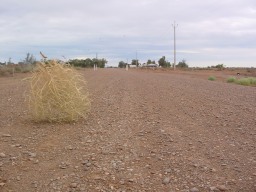
Roy Orbison hailed from nearby Wink, Texas, which is just the other side of Notrees, Texas. (No, there are no trees in Notrees, Texas.) My father and aunt saw Roy play at their high school dances back before he became famous. Here he's doing "Only the Lonely," which goes out to La Reina, who I cry out for like a coyote when she's so far away. A genuine Texas tumbleweed.
We saw one on the road from the airport to the house. Felt like a cosmic, "Welcome Back, Son."
Another West Texas boy, Buddy Holly (from Lubbock), sings "Peggy Sue." (Ah, Buddy, you died too soon.)
And just to show the range of Texas culture, here's a clip of Kilgore boy Van Cliburn playing Liszt's Hungarian Rhapsody No.12. In 1958, at the heighth of the Cold War, Cliburn won the First International Tchaikovsky Competition in Moscow, a stunning accomplishment at the time. He was welcomed back to the USA with a ticker-tape parade in New York City and made the cover of Time, with the headline: "The Texan Who Conquered Russia." According to Wikipedia, Cliburn's "subsequent recording of Tchaikovsky's Piano Concerto No. 1, became the first classical album to sell a million copies. It was the best-selling classical album in the world for more than a decade, eventually going triple-platinum."
Since my own experience is a Tex-Mex one, I thought I'd include some Tejano music, courtesy of Flaco Jimenez, Freddy Fender, Doug Sahm and Augie Meyers, better known as the Texas Tornadoes: "Hey, Baby, Que Paso?"
Gonna go heat up some tamales and open a Shiner Bock. See y'all real soon. . . .
Thursday, September 14, 2006
Ann Richards (1933-2006)
 After bashing the Democrats yesterday, one of the few I really liked upped and died. Damn it, Ann.
She was the REAL Texas politician - not the Connecticut Bushes who came down for the oil. I've included some of her quotes below. But to really get a sense of her in action, try this hilarious speech at the Washington Gridiron Club (transcript courtesy of the Texas State Archives), where she gets to roast George Bush and all of the Republican and Democratic presidential candidates in the 1992 election.
The Austin American-Statesman offers quite a bit of coverage, but you have to do a free subscription, to read anything, so here's an article about her from the Brits.
Ann Richards:
"
"The here and now is all we have, and if we play it right it's all we'll need."
"There's something a little scary about funny women. There was a survey done one time where they asked women what they were most afraid of from men. And their response was they were most afraid of being hit or beaten or hurt from men. They asked men what they were most afraid of from women, and they said being laughed at."
"They blame the low income women for ruining the country because they are staying home with their children and not going out to work. They blame the middle income women for ruining the country because they go out to work and do not stay home to take care of their children."
"Let me tell you, sisters, seeing dried egg on a plate in the morning is a lot dirtier than anything I've had to deal with in politics."
"I have always had the feeling I could do anything and my dad told me I could. I was in college before I found out he might be wrong."
"I thought I knew
"I've always said that in politics, your enemies can't hurt you, but your friends will kill you."
"Teaching was the hardest work I had ever done, and it remains the hardest work I have done to date."
 Ann Richards on How to Be a Good Republican:
1. You have to believe that the nation's current 8-year prosperity was due to the work of Ronald Reagan and George Bush, but yesterday's gasoline prices are all
2. You have to believe that those privileged from birth achieve success all on their own.
3. You have to be against all government programs, but expect Social Security checks on time.
4. You have to believe that AIDS victims deserve their disease, but smokers with lung cancer and overweight individuals with heart disease don't deserve theirs.
5. You have to appreciate the power rush that comes with sporting a gun.
6. You have to believe . . . everything Rush Limbaugh says.
7. You have to believe that the agricultural, restaurant, housing and hotel industries can survive without immigrant labor.
8. You have to believe God hates homosexuality, but loves the death penalty.
9. You have to believe society is color-blind and growing up black in
10. You have to believe that pollution is OK as long as it makes a profit.
11. You have to believe in prayer in schools, as long as you don't pray to Allah or Buddha.
12. You have to believe Newt Gingrich and Henry Hyde were really faithful husbands.
13. You have to believe speaking a few Spanish phrases makes you instantly popular in the barrio.
14. You have to believe that only your own teenagers are still virgins.
15. You have to be against government interference in business, until your oil company, corporation or Savings and Loan is about to go broke and you beg for a government bail out.
16. You love Jesus and Jesus loves you and, by the way, Jesus shares your hatred for AIDS victims, homosexuals, and President Clinton.
17. You have to believe government has nothing to do with providing police protection, national defense, and building roads.
18. You have to believe a poor, minority student with a disciplinary history and failing grades will be admitted into an elite private school with a $1,000 voucher.

"
Take 'er easy, Ann
Subscribe to:
Posts (Atom)