"I don't try to guess what a million people will like. It's hard enough to know what I like."
John Huston
Further into the rabbit hole with my exploration of the world's Greatest Films of All Time. The initial post included an Introduction and Films 1-20. [The other posts in this series include Films 21-50, Films 51-100, and The Directors.]
You can skip the following brief intro if you've already read the other posts.
Briefly, I researched and compiled 30 lists of Greatest Films from various sources around the globe, including critics such as Roger Ebert and Jonathan Rosenbaum; popular magazines like Time and Time Out (UK); films journals such as Sight & Sound, Cahiers du cinema, Kinovedcheskie Zapiski (Russia); and a range of Film Archives from countries like China, India, Ecuador, Israel, Greece, and Finland.
The 30 polls produced a total of 580 films. When films weren't ranked in the polls, I assigned a numeric value depending on the total number of films included (eg. 100 films = 20 points). So, the list I'm presenting is not a ranking of films I personally think are the greatest of all time. It's simply a reflection of results from across 30 polls voted on by hundreds of other people.
My quest was twofold: To see which works were considered the masterpieces of cinema from a variety of international sources, and to see if and how the perception of great films and great directors varied from one region of the world to another.
Films 101-200
 Luis Buñuel's delicious and disturbing Exterminating Angel, ranked #177 and among my own 100 Favorite Films.
Since this list is pretty long, I'm not going to offer much comment. There were a few points of interest, however.
Several classic comedies from the 1930s and 1940s, which seemed ignored in the more serious-minded Top 100, show up in this list. Howard Hawks' two defining screwball classics appear: Bringing Up Baby (#112) and His Girl Friday (#155) , which may have the fastest-spoken dialog in cinema history. Wisecracking only for the initiated.
Ernst Lubitsch and Preston Sturges each notch two entries, the former with the delightful Trouble in Paradise (#118) and The Shop Around the Corner (#185), and the latter with the magnificent The Lady Eve (#119) and Sullivan's Travels (#185). The only Marx Brothers film in the Top 200, Duck Soup (#125), shows up. And two of my favorite comedies - George Cuckor's wonderful The Philadelphia Story (#144) and Frank Capra's It Happened One Night (#152) - deservedly make the list.
The first films from the 21st century appear: David Lynch's skewed riff on Sunset Blvd., Mulholland Drive (#173) and Wong Kar Wai's In the Mood for Love (#188).
The famous British directing team of Michael Powell & Emeric Pressburger, who didn't have any films in the Top 100, wind up with four in this list: The Life and Death of Colonel Blimp (#109); A Matter of Life and Death (#113); Black Narcissus (#138), which I highly recommend; and The Red Shoes (#164).
Here's the full list:
 101. (tie) Notti di Cabiria, Le [Nights of Cabiria] (1957) Federico Fellini 184.5
101. (tie) On the Waterfront (1954) Elia Kazan 184.5
103. Zangiku monogatari [Story of the Late Chrysanthemums] (1939) Kenji Mizoguchi 184
104. My Darling Clementine (1946) John Ford 181.5
105. Thiassos, O [Traveling Players] (1975) Theodoros Angelopoulos 178
106. (tie) Jazz Singer, The (1927) Alan Crosland 175
106. (tie) Olvidados, Los [The Young and the Damned] (1950) Luis Buñuel 175
108. Nashville (1975) Robert Altman 172.5
109. Life and Death of Colonel Blimp, The (1943) Michael Powel & Emeric Pressburger 170.5
110. Partie de Campagne [A Day in the Country] (1936) Jean Renoir 170
111. Pandora's Box (1928) G.W. Pabst 165
112. Bringing up Baby (1938) Howard Hawks 158.5
113. Matter Of Life And Death, A (1946) Michael Powel & Emeric Pressburger 157.5
114. King Kong (1933) Merian C. Cooper & Ernest B. Schoedsack 154
115. Condamné à mort s'est échappé, Un, ou Le vent souffle où il veut [A Man Escaped] (1956) Robert Bresson 150.5
116. Journal d'un curé de campagne [Diary of a Country Priest] (1950) Robert Bresson 149
117. Sherlock Jr. (1924) Buster Keaton 147
118. Trouble in Paradise (1932) Ernst Lubitsch 145.5
119. Lady Eve, The (1941) Preston Sturges 143
120. Belle et la bête, La [Beauty and the Beast] (1946) Jean Cocteau 141
121. Battaglia di Algeri, La [The Battle of Algiers] (1965) Gillo Pontecorvo 138.5
122. Blaue Engel, Der [Blue Angel] (1930) Josef von Sternberg 135
123. (tie) Letzte Mann, Der [The Last Laugh] (1924) F.W. Murnau 130
123. (tie) Zemyla [Earth] (1930) Aleksandr Dovzhenko 130
125. Duck Soup (1933) Leo McCarey 128.5
126. Crowd , The (1928) King Vidor 128
127. Nanook of the North (1922) Robert Flaherty 127
128. (tie) Play Time (1967) Jacques Tati 125
128. (tie) Umberto D (1952) Vittorio De Sica 125
130. Maltese Falcon, The (1941) John Huston 120.5
131. Ran (1985) Akira Kurosawa 117.5
132. (tie) Great Dictator, The (1940) Charlie Chaplin 117
132. (tie) Jetée, La [The Jetty] (1962) Chris Marker 117
 Chris Marker's 1962 science-fiction film La Jetée, a 28-minute work composed of still photographs. It served as the inspiration for Terry Gilliam's Twelve Monkeys (1995).
134. (tie) Aparajito (1956) Satyajit Ray 115
134. (tie) Apur Sansa [The World of Apu] (1959) Satyajit Ray 115
136. Clockwork Orange, A (1971) Stanley Kubrick 108.5
137. Nuit et Brouillard [Night and Fog] (1955) Alain Resnais 107
138. (tie) Black Narcissus (1947) Michael Powel & Emeric Pressburger 106.5
138. (tie) Vredens dag [Day of Wrath] (1943) Carl Dreyer 106.5
140. (tie) Shoah (1985) Claude Lanzmann 105
140. (tie) Ukigumo [Floating Clouds] (1955) Mikio Naruse 105
140. (tie) Vampires, Les (1915-16) Louis Feuillade 105
143. Performance (1970) Nicholas Roeg 103
144. (tie) Jeanne Dielman 23 Quai du Commerce, 1080 Bruxelles (1975) Chantal Ackerman 102
144. (tie) Philadelphia Story, The (1940) George Cukor 102
146. Treasure of Sierra Madre, The (1948) John Huston 101.5
147. Senso (1954) Luchino Visconti 101
148. (tie) Johnny Guitar (1954) Nicholas Ray 100
148. (tie) Stagecoach (1939) John Ford 100
148. (tie) Vivre sa vie [My Life to Live] (1962) Jean-Luc Godard 100
148. (tie) Wind, The (1928) Victor Sjöström 100
152. It Happened One Night (1934) Frank Capra 98.5
153. (tie) Monsieur Verdoux (1947) Charlie Chaplin 98
153. (tie) Star Wars (1977) George Lucas 98
155. His Girl Friday (1940) Howard Hawks 97.5
156. (tie) Foolish Wives (1922) Erich von Stroheim 95
156. (tie) Once Upon a Time in America (1983) Sergio Leone 95
158. Paisà [Paisan] (1946) Roberto Rossellini 93
159. Manhattan (1979) Woody Allen 92
160. Laura (1944) Otto Preminger 91
161. Berlin: Die Sinfonie der Großstadt [Berlin, Symphony of a City] (1927) Walter Ruttmann 90
162. (tie) Olympia, Parts 1 and 2 (1938) Leni Riefenstahl 89
162. (tie) Sweet Smell of Success, The (1957) Alexander Mackendrick 89
164. (tie) Vangelo secondo Matteo, Il [The Gospel According to Saint Matthew] (1964) Pier Paolo Pasolini 87.5
164. (tie) Red Shoes, The (1948) Michael Powel & Emeric Pressburger 87.5
166. Ukigusa [Floating Weeds] (1959) Yasujiro Ozu 85.5
167. (tie) Banshun [Late Spring] (1949) Yasujiro Ozu 85
167. (tie) Jalsaghar [The Music Room] (1958) Satyajit Ray 85
167. (tie) Oktyabr [October] (1927) Sergei M. Eisenstein 85
170. 2 ou 3 choses que je sais d'elle [2 or 3 Things I Know About Her] (1967) Jean-Luc Godard 83
171. Rocco e i suoi fratelli [Rocco and His Brothers] (1960) Luchino Visconti 82.5
172. Las hurdes [Land without Bread] (1932) Luis Buñuel 82
173. (tie) Charme discret de la bourgeoisie, Le [The Discreet Charm of the Bourgeoisie] (1972) Luis Buñuel 81.5
173. (tie) Mulholland Dr. (2001) David Lynch 81.5
175. (tie) Piano, The (1993) Jane Campion 81
175. (tie) Sans Soleil [Sunless] (1983) Chris Marker 81
177. Ángel exterminador, El [Exterminating Angel] (1962) Luis Buñuel 80.5
178. (tie) Bonnie and Clyde (1967) Arthur Penn 80
178. (tie) Maman et la putain, La [The Mother and the Whore] (1973) Jean Eustache 80
178. (tie) Scarlet Empress, The (1934) Josef von Sternberg 80
181. Stalker (1979) Andrei Tarkovsky 79
182. (tie) Viskningar och rop [Cries and Whispers] (1972) Ingmar Bergman 78
182. (tie) Kaagaz Ke Phool [Paper Flowers] (1959) Guru Dutt 78
184. Nema-ye Nazdik [Close-Up] (1990) Abbas Kiarostami 77
185. Shop Around the Corner, The (1940) Ernst Lubitsch 76.5
186. Sullivan's Travels (1941) Preston Sturges 76
187. Do the Right Thing (1989) Spike Lee 75.5
188. Fa yeung nin wa [In The Mood For Love] (2000) Wong Kar Wai 75
189. (tie) Sayat Nova [Color of Pomegranates] (1968) Sergei Parajanov 75
189. (tie) Terra trema [The Earth Trembles] (1948) Luchino Visconti 75
191. Meet Me in St. Louis (1944) Vincente Minnelli 73
192. (tie) Buono, il brutto, il cattivo., Il [The Good, the Bad and the Ugly] (1966) Sergio Leone 72
192. (tie) Mean Streets (1973) Martin Scorsese 72
192. (tie) Paths of Glory (1957) Stanley Kubrick 72
195. Brief Encounter (1945) David Lean 71.5
196. (tie) Barefoot Contessa, The (1954) Joseph Mankiewicz 71
 196. (tie) Casque d'or (1952) Jacques Becker 71
196. (tie) Deer Hunter, The (1978) Michael Cimino 71
196. (tie) Moonfleet (1955) Fritz Lang 71
196. (tie) Plaisir, Le (1952) Max Ophüls 71
196. (tie) Snow White and the Seven Dwarfs (1937) Walt Disney 71
Films ranked 101-200 that show up in my own list of Favorite 100 Films: Bringing Up Baby, The Maltese Falcon, Ran, The Philadelphia Story, It Happened One Night, His Girl Friday, Manhattan, and The Exterminating Angel.
The final installment in my series will be on the men and women who directed the Greatest Films of All Time. I encountered numerous surprises while taking a look at the directors who showed up in the 30 polls. In fact, I would go as far to say that the results changed my thinking about some of our masters of cinema. The cultural variations were also fascinating.
In the meantime, I'd be curious, once again, to know some of your own experiences with these films. And which ones would you put in your own Top 100?
Coming soon to this blog - The Directors!

Saturday, September 13, 2008
The Greatest Films of All Time: 101-200


Thursday, October 19, 2006
Recent Screenings
The Illusionist (2006) - Written and directed by Neil Burger, starring Edward Norton, Jessica Biel and Paul Giamatti.
 One of the most enjoyable experiences I’ve had at the cinema in a long time. How heartening that the film industry can still produce an intelligent, well-written, well-crafted and thoroughly entertaining film once in a while. It’s not an indie film – this is a classic
Le Mépris (Contempt) (1963) - Directed by Jean-Luc Godard, cinematography by Raoul Coutard, starring Brigitte Bardot, Michel Piccoli, Jack Palance and Fritz Lang.
 If you ever wondered what Godard might have been like as a
'I Know Where I'm Going!' (1945) - Written and directed by Michael Powell and Emeric Pressburger, starring Wendy Hiller and Roger Livesey.
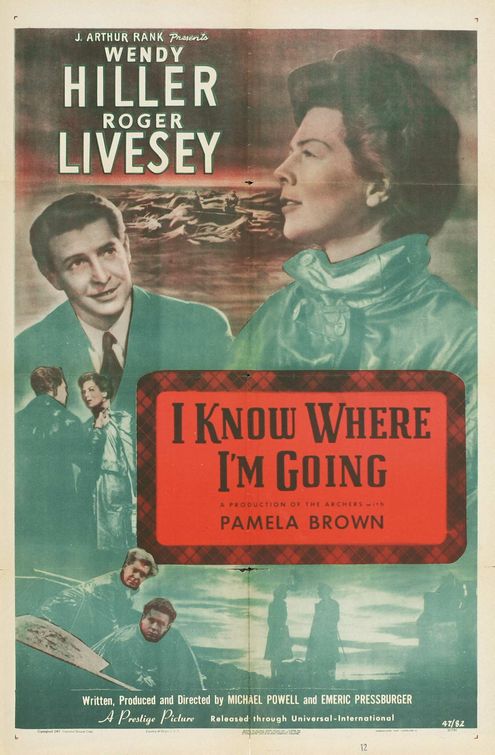 I discovered the British filmmaking duo Powell & Pressburger via IMDB’s Classic Film Board, where several of their movies are included in an ongoing (and fairly interesting) Top 200 film list. To describe I Know Where I’m Going as a romantic comedy really doesn’t do it justice. First of all, it’s set in the stormy, moody Hebrides Islands of Scotland. It’s not a slapstick romantic comedy but something more natural, with touching performances by Wendy Hiller and Roger Livesey. Hiller was also no ordinary actress but had been handpicked by George Bernard Shaw to star in his productions of Saint joan and Pygmalion. Her strong-willed Joan Webster “knows where she’s going,” only things don’t work out quite as planned. I hate to say too much about the plot because it unfolds so pleasantly and organically. I will say that La Reina liked this film very much, and we had to watch most of it again the next day. It’s just a marvel of good acting, good writing, good story and good filmmaking. A funny, very human movie. HIGHLY RECOMMENDED.
Before Sunset (2004) – Directed by Richard Linklater, starring Ethan Hawke and Julie Delphy.
 I enjoyed Before Sunrise (1995), Linklater’s first film with Hawke and Delphy playing these same characters (Jesse and Celine), but avoided this one for some reason. Maybe I wasn’t sure there should have been a second film. The idea of two young people meeting unexpectedly in Europe and having a brief but intense relationship seemed fairly realistic as it was portrayed, but those kind of fleeting relationships are exactly that – fleeting, and one doesn’t usually meet up with the same person ten years later. But I was pleasantly surprised when we finally watched Before Sunset. Written by Linklater, Hawke and Delphy, the dialogue-heavy screenplay works well and was nominated for an Oscar and three other film awards (losing each time to Sideways.) Basically, Jesse – a struggling writer - has finally published a novel that's based on his experience with Celine that was detailed in the first film. When he comes to Paris do a book-signing, she shows up, and they spend the afternoon walking around the city, discussing their brief relationship, what’s happened to them since then, and other topics of interest to two intelligent and cultured people who have the benefit of a screenplay to work from. My only real complaint about the film is that their conversation seems too natural and perfect. But they both imbue their characters with interesting touches of humanity, and Paris (the third actor in this film) looks stunning in her gown of late afternoon light. What saves the film from being overly precious is the heartfelt struggle of two people in their late 30s trying to see if their deeply romantic ideals have any place left in their increasingly mundane lives. It’s achingly and honestly nostalgic. And I could relate. Too well, perhaps. RECOMMENDED.
Pal Joey (1957) - Directed by George Sidney, music by Richard Rogers and Lorenz Hart, starring Frank Sinatra, Rita Hayworth and Kim Novak.
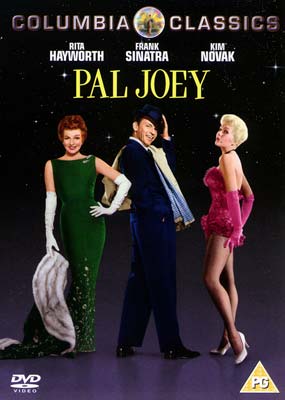 Along with the Gershwins and Cole Porter, I love the music of Rodgers and Hart. If you don’t know or don’t remember how good they were, I suggest investing a little capital in Ella Fitzgerald’s Rodgers and Hart Songbook, Vol.1 & Vol.2, which were the first, and are still considered the best, of her songbooks of American composers. So when I saw the trailer for Pal Joey, I ignored Sinatra’s cheesy monologue and listened in amazement as one great Rodgers and Hart tune after another went by in 5-second blips. A few moments later, I was on the internet, reserving a copy of the DVD from my local library. As it turns out, the film version of this Broadway production holds up pretty well. Though sanitized for 1950s
Chitty Chitty Bang Bang (1968) - Directed by Ken Hughes, screenplay by Roald Dahl (from an Ian Fleming novel), starring Dick Van Dyke, Sally Ann Howes and Lionel Jeffries.
 Chitty Chitty Bang Bang gets a bum rap, if you ask me. Slapped unjustly with the “kid’s movie” label, it gets stuck on a shelf where adults forget to look for it. At the public library, I literally had to go up into the Children’s Room to find the DVD. Yes, it is a great “kid’s movie,” but it’s also a highly imaginative and well-crafted film, period. Based on an Ian Fleming novel (yes, the James Bond guy), with a screenplay by Roald Dahl (yes, that Roald Dahl) and produced by Albert Broccoli, who produced the "Sean Connery" Bond films, Chitty Chitty Bang Bang is really a magical comedy-adventure set to music. The delightful score is by Richard and Roger Sherman, who were nominated for nine Oscars for Mary Poppins, and won two, and were nominated for this film as well. I'll bet you money that you can't see this movie and not spend the next two days singing "our fine, four-fendered friend" while driving around in your car. Dick Van Dyke is wonderful as the eccentric inventor Caractacus Potts. I had forgotten what a complete performer Van Dyke really was, singing and dancing very well, and bringing great comic presence and timing to the role. Lionel Jeffries takes a fun turn as Grandpa Potts, and Sally Ann Howes, a Tony-award winning British stage actress, shines in the role of Truly Scrumptious, daughter of the candy factory owner. But the best performance of the film, and one that lingers longer than you want it to, may be that of Robert Helpmann, who plays the creepy and chilling “Child Catcher.” The film moves along at a good pace and, for dessert, offers the delirious