The only Royal Wedding that captures my interest. Fred Astaire and Jane Powell performing a great tune by Burton Lane and Alan Jay Lerner - with one of the longest song titles ever: "How Could You Believe Me When I Said I Loved You When You Know I've Been a Liar All My Life?"
Showing posts with label Film Musicals. Show all posts
Showing posts with label Film Musicals. Show all posts
Friday, April 29, 2011
Royal Wedding


Friday, March 13, 2009
A Gershwin Friday: How Long Has This Been Going On?
 "How Long Has This Been Going On?" was originally written by the Gershwins as a duet in the 1927 Broadway musical Smarty, which had a book by Robert Benchley of the Algonquin Round Table and New Yorker fame (and grandfather of Jaws novelist Peter Benchley.) After unsuccessful previews in Philadelphia, the show was rewritten (Benchley departed), revised, and renamed, and "How Long Has This Been going On?" was dropped. The reconfigured show, now called Funny Face, wound up being another huge hit for the brothers Gershwin and for brother and sister stars Fred and Adele Astaire.
As it turns out, though, Florenz Zeigfeld liked "How Long Has This Been Going On?," and it reappeared a few months later in his production of Rosalie, which already had compositions by two other famous songwriters: composer Sigmund Romberg and lyricist P.G. Wodehouse. Under pressure to finish the show in time, Romberg suggested that the Gershwins write half of the show, which they did. To fit "How Long" into the new show, Ira changed the lyrics a bit, transforming it from a duet to a solo piece.
When MGM made a film version of Funny Face in 1957, they dropped all but four of the original songs from the Broadway production.* But they brought back "How Long Has This Been Going On?" after it had been dropped from the show 30 years earlier.
Audrey Hepburn sings the solo version in the film, and while she may not have a great or powerful voice, she was . . . Audrey Hepburn. It's one of the more poignant songs by the Gershwins and I think she captures the wonder, longing and sadness well.
And here's a beautiful instrumental version by the great tenor saxophonist Ben Webster, with Kenny Drew on Piano, the awesome (and awesomely named) Danish double bass player Niels-Henning Ørsted Pedersen, and Alex Riel on Drums.
* It wasn't unusual for Hollywood to butcher Broadway musicals. When MGM turned Rosalie into a film in 1937, they weren't satisfied with music by hacks like George and Ira Gershwin or Romberg and Wodehouse. They dropped ALL of the songs and brought in Cole Porter to do entirely new ones.
[CORRECTION: In my original post, I said Robert Benchley was Peter Benchley's father. He was his grandfather.]
Friday, December 12, 2008
A Gershwin Friday: Stairway To Heaven
 Gershwin - by Warhol
Fifty years before Led Zeppelin tried their hand at the concept, George Gershwin composed "I'll Build a Stairway to Paradise" for George White's Scandals of 1922. The lyrics were by his brother Ira (under the pseudonym Arthur Francis) and Buddy DeSylva, with whom George had written his first complete musical, the very successful La La Lucille, in 1919.
Probably the most famous version of "I'll Build a Stairway to Paradise" is the one from the great 1951 musical, An American in Paris, starring Gene Kelly and Oscar Levant, who had been Gershwin's friend and musical interpreter. Georges Guétary performs the song amidst one of those amazing MGM sets, with pink stairs that light up as he ascends, a bevy of beautiful show girls, and Cocteau-like women forming giant, surreal candelabras. The song as originally performed in George White's Scandals of 1922 also involved an elaborate stairway set.
Though Guétary's version is my favorite - love the French intro - musical channeler Rufus Wainwright recently gave the song a good whirl in Martin Scorsese's 2004 film, The Aviator. Here's Rufus performing the song on Conan O'Brien.
Neither of these versions actually contains the complete song. Guétary skips the first half of the first verse, which I like, and which Wainwright nails, especially on the soundtrack. And both men skip the last half of the original.
As far as I'm aware, there is no known version by Jimmy Page and Robert Plant.
"I'll Build a Stairway to Paradise"
(George Gershwin, Ira Gershwin, Buddy DeSylva)
All you preachers
Who delight in panning the dancing teachers,
Let me tell you there are a lot of features
Of the dance that carry you through
The gates of Hea-ven.
It's madness
To be always sitting around in sadness,
When you could be learning the steps of gladness.
You'll be happy when you can do
Just six or seven;
Begin today!
You'll find it nice,
The quickest way to paradise.
When you practice,
Here's the thing to do,
Simply say as you go...
I'll build a stairway to Paradise
With a new step every day!
I'm going to get there at any price;
Stand aside, I'm on my way!
I've got the blues
And up above it's so fair.
Shoes! Go on and carry me there!
I'll build a stairway to Paradise
With a new step ev'ry day.
Ev'ry new step
Helps a bit ; but any old kind of two step,
Does as well. It don't matter what step you step,
If you work it into your soul
You'll get to Heaven.
Get bu-sy ;
Dance with Maud the countess, or just plain Lizzy:
Dance until you're blue in the face and dizzy.
When you've learn'd to dance in your sleep
You're sure to win out.
In time you'll get Saint Vitus dance,
Which beats the latest thing from France.
Take no chances on this Paradise ;
Let me give you advice.
I'll build a stairway to Paradise
With a new step every day!
I'm going to get there at any price;
Stand aside, I'm on my way!
I've got the blues
And up above it's so fair.
Shoes! Go on and carry me there!
I'll build a stairway to Paradise
With a new step ev'ry day.
Friday, July 25, 2008
A Gershwin Friday: The Jewish Cowboy Musical
 Bronco busters Jacob and Israel Gershowitz (George and Ira Gershwin)
For me, the name Gershwin has always conjured up 1920s New York sophistication. George and Ira hanging out with Fred Astaire and Kay Swift in George's immaculate 5th Avenue art deco penthouse. Parties with young socialites and the artistic elites of the day. Soirées with great Harlem musicians such as James P. Johnson and Willie "the Lion" Smith" playing on George's grand piano.
Lest we forget, however, George and Ira also tackled the cactus and cowboys of the great American west. Their 1930 Broadway show, Girl Crazy, concerns the romantic adventures of Danny Churchill, a young playboy from Manhattan who's been chasing too much skirt and gets sent by his father to a small men's college in Arizona.
Gieber Goldfarb, a Jewish cabbie, drives Danny from 48th Street all the way out west. He winds up staying with Danny and encounters his own adventures - basically being an urban New York Jew trying to survive among rattlesnakes and roughnecks. At one point, about to be lynched by cowboys, Goldfard asks, "So, this is God's country?"
Later, Goldfard disguises himself as a Native American, only to encounter a real Native American named Eaglerock. Andrea Most describes the ensuing scene in her article, "'Big Chief Izzy Horowitz': Theatricality and Jewish Identity in the Wild West" [American Jewish History 87.4 (1999) 313-341.] :
Eaglerock is simply dressed, speaks perfect English, and has just returned from college. When Gieber enters he assumes the pose not of a "real" Indian but of a stage Indian who wears a full headdress, whoops loudly, and speaks a strange "ugga-bugga" language which confuses Eaglerock thoroughly. The two "Indians" try a number of languages before Gieber finally introduces himself in Yiddish. This works, Eaglerock responds, and the two exit speaking animatedly.
Girl Crazy was a big success at the time and made stars of two young actresses: Ginger Rogers and Ethel Merman. Down in the orchestra pit were future big-band legends Benny Goodman, Tommy Dorsey, Glenn Miller and Gene Krupa. Hit songs from the show included "But Not for Me," "Embraceable You," and "I Got Rhythm."
But the titles that attract my attention now are those such as "The Lonesome Cowboy," "Bronco Busters," "Land of the Gay Caballero," and "(When It's) Cactus Time in Arizona." In retrospect, it shouldn't be a surprise that the Gershwins would explore the American west as subject material, given how essential it is to our national mythology. Later, of course, George would also delve into the America South for his opera Porgy and Bess.
 The 1943 film version of Girl Crazy, with Judy Garland and Mickey Rooney, removed the Jewish elements of the plot.
A few years after Girl Crazy, George and Ira would themselves follow the cattle trail out west (via modern airplane), lured by the siren call of Hollywood. We may think of George Gershwin as being one with New York City - Woody Allen's Manhattan! - but he actually died in Los Angeles in 1937.
In 1943, MGM decided that this Jewish cowboy musical was a perfect vehicle for the ninth pairing of Judy Garland and Mickey Rooney. Sadly, however, the studio removed Gieber Goldfarb and his adventures, as well as his song "Goldfarb, That's I'm!," converting the Gershwins' interesting cultural mix and comic fantasy of a fellow Jewish New Yorker out in the wilds of Arizona into a more comfortable and bland WASP vision of the American west.
It's interesting to note that this erasure of the Jewish elements of the story took place at a time when news about the concentration camps was first coming out of Europe. And that the head of of the studio, Louis B. Mayer, was Jewish himself. Evidently, Hollywood didn't think that a Jewish cabbie and a well-spoken Native American communicating in Yiddish would play in Peoria as it had on Broadway.
What the film does offer, however, is Judy Garland at the height of her vocal powers. And a typically surreal and mind-boggling musical number from Busby Berkeley. Busby was the original director for the movie, but he and Garland clashed on the set, so he was replaced by Norman Taurog. One of the few traces that remain of Berkeley's work is the bizarre finale that features a Tommy Dorsey big-band version of "I Got Rhythm," set out west, with cowboy outfits (perhaps the geekiest ever seen on screen), fake cactus, synchronized six-guns, a cannon fired directly at the audience, and strange, whip-like banners that remind me of Kurosawa.
It all adds up to classic Hollywood weirdness. (Especially the last minute of the video.)
 The 1943 film version of Girl Crazy, with Judy Garland and Mickey Rooney, removed the Jewish elements of the plot.
A few years after Girl Crazy, George and Ira would themselves follow the cattle trail out west (via modern airplane), lured by the siren call of Hollywood. We may think of George Gershwin as being one with New York City - Woody Allen's Manhattan! - but he actually died in Los Angeles in 1937.
In 1943, MGM decided that this Jewish cowboy musical was a perfect vehicle for the ninth pairing of Judy Garland and Mickey Rooney. Sadly, however, the studio removed Gieber Goldfarb and his adventures, as well as his song "Goldfarb, That's I'm!," converting the Gershwins' interesting cultural mix and comic fantasy of a fellow Jewish New Yorker out in the wilds of Arizona into a more comfortable and bland WASP vision of the American west.
It's interesting to note that this erasure of the Jewish elements of the story took place at a time when news about the concentration camps was first coming out of Europe. And that the head of of the studio, Louis B. Mayer, was Jewish himself. Evidently, Hollywood didn't think that a Jewish cabbie and a well-spoken Native American communicating in Yiddish would play in Peoria as it had on Broadway.
What the film does offer, however, is Judy Garland at the height of her vocal powers. And a typically surreal and mind-boggling musical number from Busby Berkeley. Busby was the original director for the movie, but he and Garland clashed on the set, so he was replaced by Norman Taurog. One of the few traces that remain of Berkeley's work is the bizarre finale that features a Tommy Dorsey big-band version of "I Got Rhythm," set out west, with cowboy outfits (perhaps the geekiest ever seen on screen), fake cactus, synchronized six-guns, a cannon fired directly at the audience, and strange, whip-like banners that remind me of Kurosawa.
It all adds up to classic Hollywood weirdness. (Especially the last minute of the video.)
Now, how we go from Jewish cowboy musicals and a freaky Busby Berkeley number to Bird and Diz using the same song as one of the foundations of Be-Bop is . . . well . . . one of those sweet mysteries of life.
Thursday, June 19, 2008
Cyd Charisse
 Cyd Charisse in her favorite musical number, the "Dancing in the Dark" sequence with Fred Astaire in The Band Wagon (1953).
I was saddened to read this morning that Cyd Charisse had passed away on Tuesday at the age of 86. Born Tula Ellice Finklea in Amarillo, Texas, Charisse was one of those rare actresses who combined an erotic, animal physicality with elegance, grace and class. I always imagined her as something of a noble pantheress. She was certainly was one of the greatest dancers in movie musicals.
Luckily for us, she partnered on several occasions with the two greatest male dancers in film, Fred Astaire and Gene Kelly. Her dual animal/elegant nature worked perfectly with the strongest attributes of both of men. And it's notable that the best Astaire and Kelly musicals of the 1950s were the ones featuring Cyd Charisse: The Band Wagon, (1953) Silk Stockings, (1957) and Singin' in the Rain (1952).
As Astaire once famously said, "That Cyd! When you've danced with her you stay danced with."
The New York Times has an obituary (with a slideshow on her career), as well as appreciations by Verlyn Klinkenborg and Manohla Dargis.
Klinkenborg's favorite Charisse number is when she dances with her lingerie in Silk Stockings. She plays a stern Soviet commissar who has come to Paris to retrieve three Soviet emissaries who've gone astray in the city of lights. Ice cold when she arrives, she gradually gives in to Fred Astaire's romantic overtures, the charms of Paris, and the simple delights of captialism, including French lingerie. At one point, alone in her hotel room, she turns the photo of Stalin that she keeps by her bed face down on the nightstand. Furtively and with a feeling of shame at first, she begins to enjoy the silk stockings and then the nightie that she's secretly purchased. It's a beautiful, sensual number.
Part I:
Part II (a better print) is available at YouTube.
Dargis' favorite Charisse sequence is from The Band Wagon, but not the "Dancing in the Dark" scene.
I prefer the film’s “Girl Hunt Ballet,” a spoof of a Mickey Spillane pulp in which Astaire plays a detective who partners with a willowy blonde and a smokin’ brunette, both danced by Ms. Charisse. The blonde has her allure, but not the brunette’s sex appeal — or her dress, a red-hot number with tassels hanging from each torpedolike breast. “She came at me in sections,” the detective says of the brunette, with “more curves than a scenic railway.” Choreographed by Michael Kidd, the athletic number makes the most of her legs, which thrust through the front slit of her dress like a boxer’s jabs.Here's a clip:
Cyd Charisse's own favorite performance, "Dancing in the Dark," ranks as one of the most beautiful moments ever in a musical. Jeff posted about the scene a few months back. Here's Klinkenborg's description of the sequence:
And if I had to choose only one moment to remember Charisse by, it would be her silent duet with Astaire in “The Band Wagon.” The song is “Dancing in the Dark,” the setting is Central Park, and, as usual, the overlapping illusions are nearly confounding. There they are — two professional dancers, carefully choreographed and rehearsed, playing two professional dancers dancing spontaneously on a soundstage that is meant to be Central Park, and all the while they are feigning an almost reproachful, amorous awareness of each other that conceals the hard-working awareness of two pros on the job. It was Cyd Charisse’s remarkable gift to move through the hall of mirrors that is the American movie musical and never be caught glancing at herself."Dancing in the Dark"
Charisse also had several famous dance numbers with Gene Kelly. It was her appearance in Singin' in the Rain that turned her into a starring lady. It's great watching Charisse with the athletic and powerful Kelly. She complimented him well.
And though I didn't really like Brigadoon that much, I did enjoy Charisse and Kelly in the "Heather on the Hill" sequence:
Thanks, Cyd. May you dance forever. . . .

Saturday, February 16, 2008
The ZONE Primary
Forget Wisconsin and all that talk about Texas and Ohio. The only Primary that matters is the ZONE Primary. Vote NOW. (Look over on the right.)
THE CANDIDATES: Tom Waits (Rain Dog Party)
Has consistently done well with returning vets and Salvation Army Band girls.
Tom discusses his economic policy with some . . . emus? Thelonious Monk (Epistrophy Party)
Has garnered early support from younger voters, older voters, minimalists, and hep cats.
What is Epistrophy? Monk lays out his platform. Yma Súmac (Inca Princess Party)
Has a devoted base that consists of fans of obscure music, lovers of kitsch, and young men who haven't realized yet that they're homosexual. Can she attract soccer moms?
In this town hall meeting, Yma shows her ability to communicate with both the educated upper class and poor indigenous people with funny hats. Harpo Marx (Harpo Party)
Does surprisingly well with women. Also has strong support among older New York Jews nostalgic for their childhood. Completely dominates the amateur harpist vote.
Harpo speaks! Surprising views on gun control. T.S. Eliot (J. Alfred Prufrock Party)
A sexy, charismatic "rock star" who delivers impassioned speeches that critics claim are vague and filled with fluff. It's still unclear how voters will respond to his friendship with an American-born Fascist who made treasonous radio broadcasts against the United States during World War II.
Eliot delivers one of his fiery stump speeches.
(Warning: Do not watch this while drunk or on drugs. Something's not quite right.)
UPDATE: Results of the ZONE Primary . . .
A higher turnout than expected, with 17 votes cast. This was due mainly to superior organizing on the part of the Tom Waits campaign, specifically a link from a Tom Waits blog.
One crucial advantage Waits had over the other 4 challengers: he was the only living candidate. Though I'd argue that a dead Yma Sumac still would've done less damage to the planet than a living George W. Bush.
Tom Waits for President. Doesn't sound bad at all.
Tom Waits: 7 (41%)
Harpo Marx: 4 (23%)
Thelonious Monk: 3 (17%)
Yma Sumac: 2 (11%)
T.S. Eliot: 1 (5%)
Monday, October 22, 2007
Broadway Melody of 1940
 Broadway Melody of 1940 (1940) - Directed by Norman Taurog. Starring Fred Astaire, Eleanor Powell, George Murphy and Frank Morgan.
An underrated gem and one of Fred Astaire's best films from the post-Ginger Rogers era, Broadway Melody of 1940 features the music of Cole Porter, several excellent dance sequences, strong supporting actors, and maybe the best dancer Fred ever worked with, Eleanor Powell, who had a successful solo career of her own.
Their tap routine to Porter's "Begin the Beguine" is one of the most famous in Hollywood musicals and was given a place of honor in the original That's Entertainment.
Powell was a great dancer, but she's somewhat plain as an overall screen presence, as evidenced in the earlier Broadway Melody of 1938 as well. She does better as part of a large ensemble rather than as a romantic lead. Lacking the comic flair and sexual energy of Ginger Rogers, or the sensuality of Cyd Charise and Rita Hayworth, she treats Astaire more as a colleague than a potential lover, which lessens any erotic undercurrent in their dances. There's an edge missing from some otherwise superb routines. But it doesn't really matter much in the end, because they're both so great on the floor, and there's more than enough in the film to make up for their lackluster romantic chemistry.
There are two dance sequences without Powell that would make the film a must-see anyway: Astaire and Murphy doing a great job with Porter's delightful "Please Don't Monkey with Broadway" (a terrific New York song), and Fred's marvelous solo piece to "I've Got My Eyes on You." He begins simply at the piano, singing the song straight, but can't keep from bringing his feet into the musical mix, using them as a percussive element against the side of the piano as he continues playing. But the urge to dance becomes too great, and he's suddenly up and around the room, with one of his most enjoyable and skillful routines. Bosley Crowther, in the original New York Times review from 1940, said, "Astaire's rhythmic arabesques . . . seem even more fascinatingly intricate than ever before."
 The story features Johnny Brett (Astaire) and King Shaw (George Murphy) as dance partners who came to New York hoping to make it on Broadway but never had much luck. They're running out of money and close to breaking up the act. Trying to outwit a bill collector, they wind up switching names, which causes problems when a producer, played by the always delicious Frank Morgan (The wizard in The Wizard of Oz and one of Hollywood's great character actors) tries to hire Brett for a new show and winds up with Shaw by mistake. Overwhelmed with his sudden notoriety, Shaw gets a big head, starts partying too much, and almost ruins the show. Brett, the better talent, tags along to help his partner learn his dance moves, but tension builds up as they both fall in love with the show's star, played by Powell. When Shaw turns up drunk on opening night, a crisis ensues. How will it all turn out? (Fine, of course, but one enjoys going from point A to point B.)
The film moves along at a good pace, directed efficiently by Norman Taurog, who knocked out an incredible 180 movies in a career that spanned from 1920 to 1968 and included most of the Dean Martin-Jerry Lewis films, as well as Elvis Presley's cinematic oeuvre. Along the way, we're treated to an amazing juggling routine by Trixie Firschke, an hilariously bad and bizarre audition, and several comic moments, including a running gag that has Frank Morgan using a mink stole to pick up young beauties.
Though the tap routine to "Begin the Beguine" became very famous, it's actually the last part of a long sequence that features amazing set designs - with mirrored walls, darkened glass floors and celestial lights - and Astaire in a flamenco costume at one point. There's a brief entre-acte with some absolutely horrific plaid outfits on the women (where was Edith Head when they needed her!) that don't seem related to anything else. The sequence is overly long but wonderfully surreal.
Don't confuse this film with the original Broadway Melody (1929) or its two successors in 1936 and 1938. Those are okay, but this one is far superior, mostly because of the addition of Astaire and Cole Porter.
RECOMMENDED
Friday, October 27, 2006
Thursday, October 19, 2006
Recent Screenings
The Illusionist (2006) - Written and directed by Neil Burger, starring Edward Norton, Jessica Biel and Paul Giamatti.
 One of the most enjoyable experiences I’ve had at the cinema in a long time. How heartening that the film industry can still produce an intelligent, well-written, well-crafted and thoroughly entertaining film once in a while. It’s not an indie film – this is a classic
Le Mépris (Contempt) (1963) - Directed by Jean-Luc Godard, cinematography by Raoul Coutard, starring Brigitte Bardot, Michel Piccoli, Jack Palance and Fritz Lang.
 If you ever wondered what Godard might have been like as a
'I Know Where I'm Going!' (1945) - Written and directed by Michael Powell and Emeric Pressburger, starring Wendy Hiller and Roger Livesey.
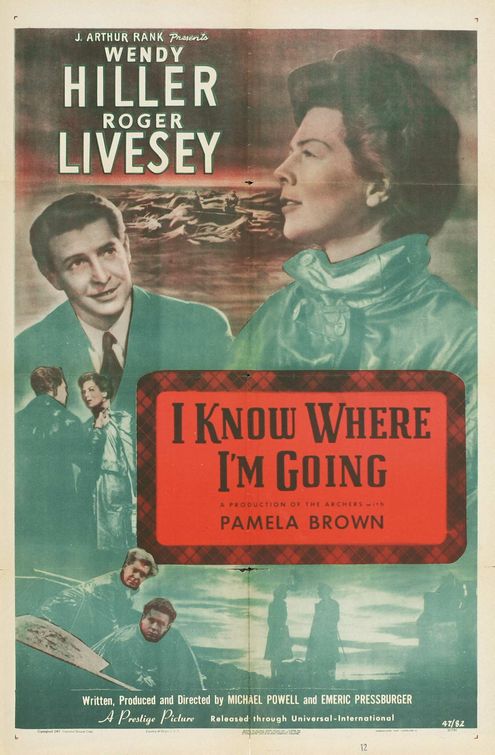 I discovered the British filmmaking duo Powell & Pressburger via IMDB’s Classic Film Board, where several of their movies are included in an ongoing (and fairly interesting) Top 200 film list. To describe I Know Where I’m Going as a romantic comedy really doesn’t do it justice. First of all, it’s set in the stormy, moody Hebrides Islands of Scotland. It’s not a slapstick romantic comedy but something more natural, with touching performances by Wendy Hiller and Roger Livesey. Hiller was also no ordinary actress but had been handpicked by George Bernard Shaw to star in his productions of Saint joan and Pygmalion. Her strong-willed Joan Webster “knows where she’s going,” only things don’t work out quite as planned. I hate to say too much about the plot because it unfolds so pleasantly and organically. I will say that La Reina liked this film very much, and we had to watch most of it again the next day. It’s just a marvel of good acting, good writing, good story and good filmmaking. A funny, very human movie. HIGHLY RECOMMENDED.
Before Sunset (2004) – Directed by Richard Linklater, starring Ethan Hawke and Julie Delphy.
 I enjoyed Before Sunrise (1995), Linklater’s first film with Hawke and Delphy playing these same characters (Jesse and Celine), but avoided this one for some reason. Maybe I wasn’t sure there should have been a second film. The idea of two young people meeting unexpectedly in Europe and having a brief but intense relationship seemed fairly realistic as it was portrayed, but those kind of fleeting relationships are exactly that – fleeting, and one doesn’t usually meet up with the same person ten years later. But I was pleasantly surprised when we finally watched Before Sunset. Written by Linklater, Hawke and Delphy, the dialogue-heavy screenplay works well and was nominated for an Oscar and three other film awards (losing each time to Sideways.) Basically, Jesse – a struggling writer - has finally published a novel that's based on his experience with Celine that was detailed in the first film. When he comes to Paris do a book-signing, she shows up, and they spend the afternoon walking around the city, discussing their brief relationship, what’s happened to them since then, and other topics of interest to two intelligent and cultured people who have the benefit of a screenplay to work from. My only real complaint about the film is that their conversation seems too natural and perfect. But they both imbue their characters with interesting touches of humanity, and Paris (the third actor in this film) looks stunning in her gown of late afternoon light. What saves the film from being overly precious is the heartfelt struggle of two people in their late 30s trying to see if their deeply romantic ideals have any place left in their increasingly mundane lives. It’s achingly and honestly nostalgic. And I could relate. Too well, perhaps. RECOMMENDED.
Pal Joey (1957) - Directed by George Sidney, music by Richard Rogers and Lorenz Hart, starring Frank Sinatra, Rita Hayworth and Kim Novak.
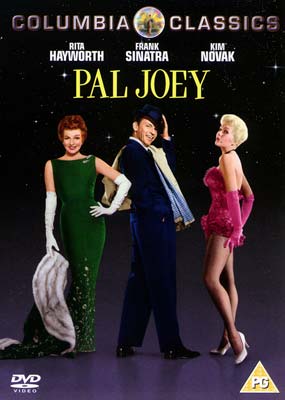 Along with the Gershwins and Cole Porter, I love the music of Rodgers and Hart. If you don’t know or don’t remember how good they were, I suggest investing a little capital in Ella Fitzgerald’s Rodgers and Hart Songbook, Vol.1 & Vol.2, which were the first, and are still considered the best, of her songbooks of American composers. So when I saw the trailer for Pal Joey, I ignored Sinatra’s cheesy monologue and listened in amazement as one great Rodgers and Hart tune after another went by in 5-second blips. A few moments later, I was on the internet, reserving a copy of the DVD from my local library. As it turns out, the film version of this Broadway production holds up pretty well. Though sanitized for 1950s
Chitty Chitty Bang Bang (1968) - Directed by Ken Hughes, screenplay by Roald Dahl (from an Ian Fleming novel), starring Dick Van Dyke, Sally Ann Howes and Lionel Jeffries.
 Chitty Chitty Bang Bang gets a bum rap, if you ask me. Slapped unjustly with the “kid’s movie” label, it gets stuck on a shelf where adults forget to look for it. At the public library, I literally had to go up into the Children’s Room to find the DVD. Yes, it is a great “kid’s movie,” but it’s also a highly imaginative and well-crafted film, period. Based on an Ian Fleming novel (yes, the James Bond guy), with a screenplay by Roald Dahl (yes, that Roald Dahl) and produced by Albert Broccoli, who produced the "Sean Connery" Bond films, Chitty Chitty Bang Bang is really a magical comedy-adventure set to music. The delightful score is by Richard and Roger Sherman, who were nominated for nine Oscars for Mary Poppins, and won two, and were nominated for this film as well. I'll bet you money that you can't see this movie and not spend the next two days singing "our fine, four-fendered friend" while driving around in your car. Dick Van Dyke is wonderful as the eccentric inventor Caractacus Potts. I had forgotten what a complete performer Van Dyke really was, singing and dancing very well, and bringing great comic presence and timing to the role. Lionel Jeffries takes a fun turn as Grandpa Potts, and Sally Ann Howes, a Tony-award winning British stage actress, shines in the role of Truly Scrumptious, daughter of the candy factory owner. But the best performance of the film, and one that lingers longer than you want it to, may be that of Robert Helpmann, who plays the creepy and chilling “Child Catcher.” The film moves along at a good pace and, for dessert, offers the delirious
Subscribe to:
Posts (Atom)