Showing posts with label Juan Cole. Show all posts

Monday, December 29, 2008

Happy Holy-Days

(AP) A Palestinian boy watches the funeral of three children in Rafah in the southern Gaza Strip December 29, 2008. Palestinian medics said five young sisters, died in an Israeli air strike in Jabalya refugee camp in northern Gaza and three other young children were killed when a bomb struck a house aimed at the nearby abandoned home of a senior Hamas militant in Rafah.


Adagio in G minor - Tomaso Albinoni

(AP) Three Palestinian brothers Sidki, 8, Ahmad, 12, and Mohammed Absi, 14, who were killed in an Israeli missile strike, during their funeral in Rafah refugee camp, southern Gaza Strip, Monday, Dec. 29, 2008.

More than 360 Palestinians have been killed. U.N. humanitarian chief John Holmes said 62 civilians were confirmed killed and the number was likely higher. Another 1,450 Palestinians have been wounded.

Two Israelis have been killed by rockets.

Washington Post: Food and Medical Supplies Grow Scarce in the Gaza Strip

Juan Cole: What Is the Israeli End Game?
What I can't understand is the end game here. The Israelis have pledged to continue their siege of the civilians of Gaza, and have threatened to resume assassinating Hamas political leaders, along with the bombardment. The campaign of brutal assassinations launched by Ariel Sharon earlier in this decade were, Sharon, promised us, guaranteed to wipe out Hamas altogether. Do the Israelis expect the population at some point to turn against Hamas, blaming it for the blockade and the bombardment? But by destroying what was left of the Gaza middle class, surely they a throwing people into the arms of Hamas. The US experience of bombing North Vietnam and mining Haiphong Harbor, etc., was that it only stiffened Hanoi's resolve. The massive Israeli bombardment of Lebanon in 2006 did not achieve any significant objectives. In fact, Hezbollah was politically strengthened; it now sits in the Lebanese cabinet and has been recognized as a formal national guard for the south of the country. Its stock of rockets has been replenished. There is a UN buffer now, but in the past such buffers have been removed when hostilities threaten.

If the Gaza population doesn't turn on Hamas, and Israeli measures don't destroy the organization (which they helped create and fund back in the late 1980s when they wanted a foil to the secular PLO), then what? They'll just go on half-starving Gaza's children for decades? Malnourished children have diminished IQ and poor impulse control. That would make them ideal suicide bombers. Plus, sooner or later there will start to be effective boycotts of Israel in Europe and elsewhere over these war crimes. The Israeli economy would be vulnerable to such moves.

Of course, there are only 1.5 million Gazans, and they increasingly are being forced to live in Haiti-like conditions, so in the short term the Israelis can do whatever they want to them. But I can't see this ending well for the Israelis in the long term. Very few insurgencies end because one side achieves a complete military victory (I think it is about 20%). But by refusing to negotiate with Hamas, Israel and the United States leave only a military option on the table. The military option isn't going to resolve the problem by itself. Gaza is a labyrinth. Those Qassam rockets are easy to make. There is so much money sloshing around the Middle East and so many sympathetic Muslims that Gaza will be kept just barely afloat economically, making Hamas hard to dislodge. And the Israeli blockade of Gaza is so distasteful to the world that eventually there is likely to be a painful price to pay for it by the Israelis.

Robert Fisk: Leaders lie, civilians die, and lessons of history are ignored
And always Mr Bush Snr or Mr Clinton or Mr Bush Jnr or Mr Blair or Mr Brown have called upon both sides to exercise "restraint" – as if the Palestinians and the Israelis both have F-18s and Merkava tanks and field artillery. Hamas's home-made rockets have killed just 20 Israelis in eight years, but a day-long blitz by Israeli aircraft that kills almost 300 Palestinians is just par for the course. . . .

We hear the usual Israeli line. General Yaakov Amidror, the former head of the Israeli army's "research and assessment division" announced that "no country in the world would allow its citizens to be made the target of rocket attacks without taking vigorous steps to defend them". Quite so. But when the IRA were firing mortars over the border into Northern Ireland, when their guerrillas were crossing from the Republic to attack police stations and Protestants, did Britain unleash the RAF on the Irish Republic? Did the RAF bomb churches and tankers and police stations and zap 300 civilians to teach the Irish a lesson? No, it did not. Because the world would have seen it as criminal behaviour. We didn't want to lower ourselves to the IRA's level.

Yes, Israel deserves security. But these bloodbaths will not bring it. Not since 1948 have air raids protected Israel. Israel has bombed Lebanon thousands of times since 1975 and not one has eliminated "terrorism". So what was the reaction last night? The Israelis threaten ground attacks. Hamas waits for another battle. Our Western politicians crouch in their funk holes. And somewhere to the east – in a cave? a basement? on a mountainside? – a well-known man in a turban smiles.
And where is Barack Obama?

Sunday, November 16, 2008

Bond Becomes a Leftist

Juan Cole doesn't normally do movie reviews, but he has an interesting analysis of the new James Bond film in "A Quantum of Anti-Imperialism."

Some excerpts:

The reviews of director Mark Forster's "Quantum of Solace" have complained about the film's hectic pace (reminiscent of Doug Liman's and Paul Greengrass's Bourne thrillers), about the humorlessness of Daniel Craig's Bond, and even about the squalid surroundings, so unlike Monaco and Prague, in which the film is set (with many scenes in Haiti and Bolivia). They have missed the most remarkable departure of all. Forster presents us with a new phenomenon in the James Bond films, a Bond at odds with the United States, who risks his career to save Evo Morales's leftist regime in Bolivia from being overthrown by a General Medrano, who is helped by the CIA and a private mercenary organization called Quantum.

. . . .

The present film takes, to say the least, a different view of popular movements of the left. [Evo] Morales is not mentioned in the film, but his movement was in the headlines while "Casino Royale" was being shot, as he challenged the old "white" elite and was denounced by the US ambassador as an "Andean Bin Laden" and his peasant followers (many of them of largely native stock) as "Taliban." Morales's nationalization of Bolivia's petroleum and natural gas and his redistribution of wealth from the wealthy elite to villagers were among the policies drawing the ire of George W. Bush and his cronies.

If Morales is not mentioned, Jean-Bertrand Aristide of Haiti is. The villain, Dominic Greene (Mathieu Amalric) remarks that while Aristide was president 2001-2004, he raised the minimum wage from 25 cents an hour to a dollar an hour. It was, he said, little enough, but caused the corporations that benefited from cheap Haitian labor to mobilize to have Aristide removed. (Aristide himself maintained that US and Canadian intelligence connived with officers at the coup against him and kidnapped him, taking him to southern Africa.) The Left analysis of American imperialism in the Western hemisphere is put in the mouth, not of a worker or ideologue, but rather of the collaborator in capitalist exploitation of America's poor neighbors. Aristide's story is a clear parallelism for the fate the CIA and Quantum are depicted as plotting for Morales.

Note that director Mark Forster's father was from conservative Bavaria, and that the family was forced to relocate to Davos in Switzerland because they were targeted by the radical Baader-Meinhoff gang after the father became wealthy on selling his pharmaceutical company. Forster's previous film, "The Kite-Runner," sympathized with the Afghans oppressed by the Soviet invasion and even shows one character refusing to be treated by a Russian-American physician. That is, Forster is no glib Third-Worldist. He and his screenwriters are simply performing the work of the intellectual, interrogating the way the wealthy and powerful in the Bush era casually overthrew (or tried to overthrow) foreign governments in the global south to get at the resources they coveted.

. . . .

Craig's Bond is an intimation of the sort of Britain that could have been, if Tony Blair had stood up to Bush and refused to be dragged into an illegal war of choice, and into other actions and policies that profoundly contradicted the principles on which the Labour Party had been founded (and you could imagine Craig's Bond voting for Old Labour, while Flemings's was obviously a Tory). In a way, this Bond stands in for Clare Short, who resigned as a cabinet minister from Blair's government in 2003 over the illegitimacy of the Iraq War.

It is a sad state of affairs that Bush's America now appears in a Bond film in rather the same light as Brezhnev's Soviet Union used to. One can only hope that President Barack Obama can adopt the sort of policies that can get Bond back on our side.
Hey, if A.O. Scott (New York Times) panned the film, it must have something going for it.

Wednesday, October 11, 2006

Eye-deep in Hell

Died some, pro patria,
non ‘dulce’ non ‘et decor’…
walked eye-deep in hell
believing in old men's lies

Ezra Pound, Hugh Selwyn Mauberley (1920)

UN Special Rapporteur for Torture, Manfred Nowak, was interviewed about Iraq for German public broadcaster ARD's news magazine program Tagesschau:

Nowak: In July and August 2006 alone, the bodies of 6500 persons were found who had been abducted and often very gravely tortured -- that is more than 100 people each day. I collaborated on this report to the extent that I interviewed various victims and non-governmental organizations. Many of them credibly reported that in their view the situation is now worse than it was under Saddam Hussein.

Under his dictatorship there was also terrible torture, but one could at least still predict who would have to fear being tortured. Today, on the other hand, the security situation is out of control to such an extent that in the final analysis every person can become a victim of abductions, summary executions, and the worst methods of torture: people's limbs are being amputated, their fingers are missing, their eyes have been put out."

Washington Post reporter Rajiv Chandrasekaran spent time in Iraq before the war and returned afterwards. He was interviewed by Juan Cole today:

Chandrasekaran: Before the war, Iraqis were petrified that one wrong step would result in arrest and imprisonment. Today, as we all know so well, the Iraqis live under a very different sort of fear. In fact, many of the Iraqis I know well say they are far more afraid now than they ever were before the war. Back then, if you kept your mouth shut and your head down, you'd be fine. Now, danger lurks everywhere.

Jane Arraf, NBC correspondent in Baghdad, posted this yesterday on MSNBC’s Blogging Baghdad:

Some readers and viewers think we journalists are exaggerating about the situation in Iraq. I can almost understand that because who would want to believe that things are this bad? Particularly when so many people here started out with such good intentions.

I'm more puzzled by comments that the violence isn't any worse than any American city. Really? In which American city do 60 bullet-riddled bodies turn up on a given day? In which city do the headless bodies of ordinary citizens turn up every single day? In which city would it not be news if neighborhood school children were blown up? In which neighborhood would you look the other way if gunmen came into restaurants and shot dead the customers?

Day-to-day life here for Iraqis is so far removed from the comfortable existence we live in the United States that it is almost literally unimaginable.

It's almost impossible to describe what it feels like being stalled in traffic, your heart pounding, wondering if the vehicle in front of you is one of the three or four car bombs that will go off that day. Or seeing your husband show up at the door covered in blood after he was kidnapped and beaten.

Imagine the worst day you've ever had in your life, add a regular dose of terror and you'll begin to get an idea of what it's like every day for a lot of people here.

And now, researchers at Johns Hopkins University report in The Lancet medical journal that approximately 655,000 Iraqis have died from war or political violence since the U.S. invasion in March 2003. That means people have been dying in Iraq at more than three times the rate than before the invasion.

The figure for the number of deaths attributable to the conflict - which amounts to around 2.5% of the population - is at odds with figures cited by the US and UK governments and will cause a storm, but the Lancet says the work, from the Johns Hopkins Bloomberg School of Public Health in Baltimore, has been examined and validated by four separate independent experts who all urged publication.

In October 2004, the same researchers published a study estimating that 100,000 Iraqis had died as a result of the war since the beginning of the March 2003 invasion, a figure that was hugely controversial. Their new study, they say, reaffirms the accuracy of their survey of two years ago and moves it on.

"Although such death rates might be common in times of war, the combination of a long duration and tens of millions of people affected has made this the deadliest international conflict of the 21st century and should be of grave concern to everyone," write the authors, Gilbert Burnham and colleagues.

"At the conclusion of our 2004 study we urged that an independent body assess the excess mortality that we saw in Iraq. This has not happened. We continue to believe that an independent international body to monitor compliance with the Geneva conventions and other humanitarian standards in conflict is urgently needed. With reliable data, those voices that speak out for civilians trapped in conflict might be able to lessen the tragic human cost of future wars."
Of the deaths, 31% were ascribed to the US-led forces. Most deaths were from gunshot wounds (56%), with a further 13% from car bomb injuries and 14% the result of other explosions.

Juan Cole takes a look at the report:

The study concludes that an average of 470 Iraqis per day have likely died as a result of political violence since March 19, 2003, though the number could be as low as 350 per day if the margin of error skewed to the low side. United Nations estimates based on figures from Iraqi morgues are more like 100 per day.

I follow the violence in Iraq carefully and daily, and I find the results plausible.
First of all, Iraqi Muslims don't believe in embalming or open casket funerals days later. They believe that the body should be buried by sunset the day of death, in a plain wooden box. So there is no reason to expect them to take the body to the morgue. Although there are benefits to registering with the government for a death certificate, there are also disadvantages. Many families who have had someone killed believe that the government or the Americans were involved, and will have wanted to avoid drawing further attention to themselves by filling out state forms and giving their address.
Personally, I believe very large numbers of Iraqi families quietly bury their dead without telling the government of all people anything about it. Another large number of those killed is dumped in the Tigris river by their killers.

Interesting conclusions are that we are wrong to focus so much on suicide car bombings. The real action is just shooting enemies down with bullets. Only 30 percent of the deaths have been caused by the US military, and that percentage has declined this year because of the sectarian war.
And, folks, this is a major civil war, with something close to 200,000 dying every year.

This study is going to have a hard ride. In part it is because many of us in the information business are not statistically literate enough to judge the sampling techniques. Many will tend to dismiss the findings as implausible without a full appreciation of how low the margin of error is this time. Second, it is a projection, and all projections are subject to possible error, and journalists, being hardnosed people, are wary of them.

Ironically enough, the same journalists who will question this study will accept without query the estimates for deaths in Darfur, e.g., which are generated by exactly the same techniques, and which are almost certainly not as solid.

Bush’s glib response: "Six hundred thousand or whatever they guessed at . . . it's not credible."

Perhaps the President thinks researchers at Johns Hopkins "guessed at" their results, because that's what he and his administration have been doing all along. Going to invade Iraq? I guess they'll greet us as saviors, with flowers in their hands. Need a plan to administrate the country after you invade it? I guess, it'll all work out. We’ll put Chalabi in charge of ev erything. Etc., etc.

But he is right about one thing: credibility is important. So, who is more credible: Researchers at Johns Hopkins University, or the Bush administration ?

Oh, his quote comes from an article this afternoon entitled: Bombs blitz Baghdad as UN warns of chaos:

In violence on the ground, the leader of a religious minority was shot dead in front of his home and US soldiers battled to control a fire triggered by a mortar attack on an ammunition store.

The latest attacks came after two days in which Baghdad police found the corpses of 110 murder victims scattered across the capital.

[U.N. Under Secretary General Jan Egeland, said,] “Our appeal goes to everybody who can curb the violence: religious, ethnic, cultural leaders have to see that this has spiralled totally out of control.”

So . . . we've spent $400,000,000,000.

The National Intelligence Estimate, “based on the considered analysis of all 16 of the US intelligence agencies,” says the invasion and occupation of Iraq has made global terrorism worse.

Almost 3,000 U.S. soldiers have been killed and over 20,000 wounded, many of them maimed for life.

Osama Bin Laden is still a free man.

And on top of it all, more people in Iraq are now being tortured and more are being killed than they were under Saddam Hussein.

I’ll let Ezra Pound finish this post, also from Hugh Selwyn Mauberley:

There died a myriad,
And of the best, among them,
For an old bitch gone in the teeth,
For a botched civilization.

Saturday, September 16, 2006

Dada Iraq

Hugo Ball performing "Karawane" at Cabaret Voltaire, 1916

From the diaries of Hugo Ball, one of the founders of Dada:

18 may 1921

“Some strange things happen. In the English budget a thousand pounds are requested to build a mosque in Mesopotamia as compensation for a tree that English soldiers pulled down. According to tradition, this tree was the genuine ‘tree of knowledge’ from the Garden of Eden from which the serpent seduced Eve. The tree of knowledge collapsed under the weight of the soldiers who were having their photograph taken in its branches.”

From Flight out of time [English translation of Die Flucht aus der Zeit]. Viking Press, 1974.

After those elephant days at the Cabaret Voltaire, Ball re-joined the Catholic church and became something of a mystic. He studied the saints John Climacus, Dionysius the Aeropagite, and Simeon Stylites, and wrote two religious works: Byzantinisches Christentum and Die Folgen der Reformation [The Consequences of the Reformation].

Meanwhile, after the British destroyed the Tree of Knowledge, their empire went into permanent decline.

Though they did manage to produce the Beatles.

Iraq, on the other hand, did smashingly well. At least if you were Sunni. And later a Bathist. And you didn't look at Saddam Hussein in the wrong way. And you didn't happened to be living there when the New Brits - whose leaders hadn't bothered to read Hugo Ball or a simple history on the British in Mesopotamia - blessed the country with Democracy. (Afterwards the New Brits' Empire went into permanent decline.)

Democracy, version 2.0


For more information on Hugo Ball, try hugoball.net.

For more information on Dada, take today's newspaper and turn to page 13. In the bottom right-hand corner, you should see some text or an image from an advertisement. Cut it out. Take the clipping outside and hand it to the first stranger you see wearing a hat. Next, remove your left shoe, place it on top of your head and begin chanting, "There are no chickens in the warehouse! There are no fish in the matrix!" When you are tired of this, or the police have come, return to your home, throw away the newspaper and write down the first 20 words that come into your head. Mail this to five friends and ask them to do the same thing. You have started a revolution. You are Dada.

Or, you can go see the big exhibit at the Museum of Modern Art in New York City, which runs until last Monday, September 11th. (Dada in an art museum. Like making a plastic mould of your breath.)

For more information on Iraq, stop reading this idiotic post and go to Juan Cole's website.

For more information on Simeon Stylites, one must definitely waste time at wastingtimewithgod.com, which offers an animated website about St. Simeon.

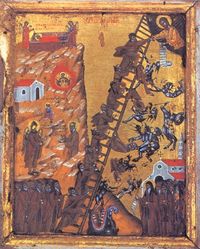
For more information on St. John Climacus and his Ladder of Divine Ascent (or, The Stairway to Paradise) [see image, left] go to Orthodoxwiki. Or listen to this recording.

For a good time, call (631) 902-3177.

For more information about information, or information about cyberspace, or nothing in particular, or nothingness in particular try this.

jolifanto bambla ô falli bambla