Showing posts with label CIA. Show all posts

Tuesday, April 19, 2011

JFK Killed by the CIA Because of his Interest in UFOs

Part of the "burned" memo, stamped Top Secret/MJ-12, rescued from a fire before it was destroyed. The memo is written by the director of Central Intelligence (circa early 1960s) and refers to Lancer (Secret Service code word for JFK), and states that he has made inquiries about their activities "which we cannot allow."

Obviously, the Cigarette Smoking Man has his hand in all of this...

Was JFK killed because of his interest in aliens? Secret memo shows president demanded UFO files 10 days before death

An uncovered letter written by John F Kennedy to the head of the CIA shows that the president demanded to be shown highly confidential documents about UFOs 10 days before his assassination.

The secret memo is one of two letters written by JFK asking for information about the paranormal on November 12 1963, which have been released by the CIA for the first time. . . .

Alien researchers say the latest documents, released to Mr Lester by the CIA, add weight to the suggestion that the president could have been shot to stop him discovering the truth about UFOs. . . .

[C]onspiracy theorists said the documents add interest to a disputed file, nicknamed the ‘burned memo’, which a UFO investigator claims he received in the 1990s.

The document, which has scorch marks, is claimed to have been posted to UFO hunter Timothy Cooper in 1999 by an unknown CIA leak, but has never been verified.

In a note sent with the document, the apparent leaker said he worked for CIA between 1960 and 1974 and pulled the memo from a fire when the agency was burning some of its most sensitive files.

The undated memo contains a reference to ‘Lancer’, which was JFK's Secret Service code name.

On the first page, the director of Central Intelligence wrote: ‘As you must know, Lancer has made some inquiries regarding our activities, which we cannot allow.

AOL News (who knew there was such a thing?!) offers a more in-depth look in The JFK-UFO Connection: Bogus Documents or Unanswered Questions?

Now, if we could just find a connection between JFK and the Knights Templar. . .

Oh, wait. Pope Clement issued the papal bull Pastoralis Praeeminentiae, ordering the arrest of all Templars and the seizure of their assets, on November 22, 1307.

Coincidence or conspiracy?

Nine seasons of the X-Files, and they couldn't do this episode?!?!?

Yes, he knows where Elvis is living.

Saturday, April 25, 2009

The Dark Side

"When you cross over that line of darkness, it's hard to come back. You lose your soul. You can do your best to justify it, but it's well outside the norm. You can't go to that dark a place without it changing you."

Unidentified former CIA interrogator

A few weeks ago, I started reading The Dark Side: The Inside Story of How the War on Terror Turned into a War on American Ideals, by Jane Mayer, a writer from the New Yorker who has been investigating the Bush administration's torture program for several years. Just as I finished the book, President Obama released four crucial memos on the program, all of which Mayer had discussed in her work.

The Dark Side may be the most disturbing book I've ever read about my own country. Not because of the accounts of torture, as bad as they were, but because it became clear after 360 pages of accumulating detail and revealing interviews, that the United States of America under the Bush administration had bureaucratized and institutionalized torture. The memos and reports released in the last week only confirm this tragic and terrifying state of affairs.

It is one thing to cross over into the dark side in the heat of the moment. In the immediate aftermath of 9/11, given the horrible nature of what happened and the genuine concern about additional attacks, it's not hard to imagine some interrogators getting out of control. (Ironically, the experienced and highly trained FBI agents conducting interrogations in late 2001 and early 2002 did not get out of control but conducted several crucial and legal debriefing sessions that revealed highly valuable information. They were subsequently removed by the CIA, with blessings from the highest levels of government, and, when it became clear that detainees were being tortured, FBI Director Robert Mueller forbade his agents from participating in further interrogations. For a good description of this devastating turn of events, see "My Tortured Decision," an op-ed by former FBI interrogator Ali Soufan, who was directly involved in the initial, pre-torture, debriefing of Abu Zubaydah.)

It is another thing altogether, however, to systematically and rationally develop a torture program, to intellectually lay out legal groundwork over a period of years for making torture the established norm. In that case, we have crossed the line of darkness and employed logic and reason to justify our new-found citizenship on the other side. We have embraced evil and legally changed its name to "light."

"[Torture] has become bureaucratized. . . . Brutalization doesn't work. We know that. Besides, you lose your soul."
Daniel Coleman, former FBI interrogator

What has genuinely puzzled and disappointed me in the past week has been Barack Obama's inconsistent pronouncements on torture, especially his vague and weak call for the country to move on, to look toward the future, by basically sweeping Bush's illegal program under the rug. Apart from the fact that a torture program violates numerous national and international laws and treaties, and the president doesn't even have the legal right to decide what can and cannot be investigated; apart from the horrible international precedent of the United States willfully refusing to investigate its own involvement in torture; I am stunned that Obama doesn't recognize what a crucial moment this is in our nation's history.

You cannot cross over the line of darkness and then hope to move forward simply by ignoring that you're on the other side now.

If individual interrogators in the CIA and FBI are speaking publicly about losing one's soul from torturing others, where does that leave us as a country, when we implemented a systematic torture program and used our legal system to justify it?

If the United States of America doesn't deal honestly and responsibly with the Bush torture program, we are betraying the very ideals upon which this nation was founded. We may "move on" by ignoring what we've done, but it won't be in the right direction.

In a 2005 piece in the Los Angeles Times, "America's Anti-Torture Tradition," Robert Kennedy, Jr. wrote:
"In 1776," wrote historian David Hackett Fischer in "Washington's Crossing," "American leaders believed it was not enough to win the war. They also had to win in a way that was consistent with the values of their society and the principles of their cause. One of their greatest achievements … was to manage the war in a manner that was true to the expanding humanitarian ideals of the American Revolution."

The fact that the patriots refused to abandon these principles, even in the dark times when the war seemed lost, when the enemy controlled our cities and our ragged army was barefoot and starving, credits the character of Washington and the founding fathers and puts to shame the conduct of America's present leadership.

Fischer writes that leaders in both the Continental Congress and the Continental Army resolved that the War of Independence would be conducted with a respect for human rights. This was all the more extraordinary because these courtesies were not reciprocated by King George's armies. . . . Captured Americans were tortured, starved and cruelly maltreated aboard prison ships.

Washington decided to behave differently. After capturing 1,000 Hessians in the Battle of Trenton, he ordered that enemy prisoners be treated with the same rights for which our young nation was fighting. In an order covering prisoners taken in the Battle of Princeton, Washington wrote: "Treat them with humanity, and let them have no reason to Complain of our Copying the brutal example of the British Army in their treatment of our unfortunate brethren…. Provide everything necessary for them on the road."

John Adams argued that humane treatment of prisoners and deep concern for civilian populations not only reflected the American Revolution's highest ideals, they were a moral and strategic requirement. His thoughts on the subject, expressed in a 1777 letter to his wife, might make a profitable read for Dick Cheney and Donald Rumsfeld as we endeavor to win hearts and minds in Iraq. Adams wrote: "I know of no policy, God is my witness, but this — Piety, Humanity and Honesty are the best Policy. Blasphemy, Cruelty and Villainy have prevailed and may again. But they won't prevail against America, in this Contest, because I find the more of them are employed, the less they succeed."
Perhaps the most disturbing piece of news that has come out in the last few days is that a number of detainees were tortured not to gain information to prevent an impending terrorist attack, but to prove the non-existent link between Al-Qaeda and Saddam Hussein, in order to justify the administration's poorly conceived invasion of Iraq. That is, the Bush administration tortured people simply to satisfy their own political agenda.

Rachel Maddow and Ron Suskind discussed this issue last Wednesday, in one of the better segments I've seen on the torture program revelations:


"They were torturing people. No question. They did disgusting things to people. Their attitude was, 'Laws? Like who the fuck cares?'"
Former CIA official with extensive knowledge of the CIA program

As usual with systematic programs of torture and brutalization, the most troubling and creepy aspect is how many innocent people became victims.
The CIA, concerned about the paucity of valuable information emanating from [Guantánamo], in the late summer of 2002 dispatched a senior intelligence analyst, who was fluent in Arabic and expert on Islamic extremism, to find out what the problem was. The report he wrote up from this sensitive, early reconnaissance mission is classified top secret. But after he left the Agency, he described what he found. . . . [H]e concluded that an estimated one-third of the prison camp's population of more than 600 captives at the time . . . had no connection to terrorism whatsoever. . . .

A later study by a team of law students and attorneys at Seton Hall University Law School bolstered the CIA officer's impressions. After reviewing 517 of the Guantánamo detainees' cases in depth, they concluded that only 8% were alleged to have associated with Al Qaeda. Fifty-five percent were not alleged to have engaged in any hostile act against the United States at all, and the remainder were charged with dubious wrongdoing, including having tried to flee U.S. bombs.
Several detainees, including ones with no connection to terrorism, were killed during interrogations. Other innocent people were tortured in secret prisons for months or even years. Mayer writes at length about one detainee, Khaled el-Masri, a car salesman from southern Germany (and a German citizen), who was detained while on holiday in Macedonia because he had a similar name to an Al Qaeda terrorist. After being tortured for a few months, it became clear that the CIA had made a mistake. Yet they refused to release him. Someone at Langley was sure he was holding out on them. Finally, after six months, the CIA flew Masri to Albania, drove him blindfolded down a long road, and kicked him out of the car. He was later flown back to Germany.
He had lost so much weight, and looked so haunted and aged, the airport authorities accused him of using someone else's passport. When he arrived at his apartment, it was deserted and ransacked. His wife and sons, he learned later, had assumed themselves abandoned and moved [to] Lebanon.
There's so much to talk about. I haven't even touched on the bizarre reverse-engineering of the military's SERE program, which was developed to help American soldiers withstand torture, into our own torture program. In a surreal and typically incompetent Bush administration twist, we took a communist program intended to produce false confessions for propaganda purposes and tried to use it to extract useful information from detainees. As Rachel Maddow said before her interview with Colonel Steve Kleinman, former military interrogator, "What could possibly go wrong?"

What gave me hope while reading The Dark Side was the brave conduct of many people in the U.S. military, the FBI, various intelligence agencies, and within the Bush administration itself, who refused to participate in the administration's torture program and who tried to stop what was happening.

The right-wing and even the mainstream media may try to paint those who are against torture as being "on the left" or "liberals," but the reality is that the push-back against the Bush torture program began among people who were usually conservative, some of them very conservative. But they believed in the U.S. Constitution and knew it was being damaged.

In one of many examples Mayer details in her book:
"The senior uniformed lawyers for the Army, Navy, Air Force, and Marines . . . all sent extraordinary memos of dissent to Haynes. . . .

The Defense Department promptly classified them as a secret. In 2005, Senator Lindsey Graham, a Republican of South Carolina, who had been a military judge advocate general himself, publicly revealed the passionate memos. He noted that the authors were 'not from the ACLU. These are not from people who are soft on terrorism, who want to coddle foreign terrorists. These are all professional military lawyers who have dedicated their lives, with 20-plus year careers, to serving the men and women in uniform and protecting their Nation. They were giving a warning shot across the bow of the policymakers that there are certain corners you cannot afford to cut because you will wind up meeting yourself.'

The memos from the uniformed lawyers to the politically appointed general counsel were brimming with barely concealed disbelief at the direction the Justice Department was proposing for the soldiers to take.
Mayer writes in the Afterword of The Dark Side:
[W]hat began on September 11, 2001, as a battle for America's security became, and continues to be, a battle for the country's soul.

In looking back, one of the most remarkable features of this struggle is that almost from the start, and at almost every turn along the way, the Bush Administration was warned that the short-term benefits of its extralegal approach to fighting terrorism would have tragically destructive long-term consequences both for the rule of law and America's interests in the world. These warnings came not just from political opponents, but also from experienced allies, including the British Intelligence Service, the experts in the traditionally conservative military and the FBI, and perhaps most surprisingly, from a series of loyal Republican lawyers inside the administration itself. The number of patriotic critics inside the administration and out who threw themselves into trying to head off what they saw as a terrible departure from America's ideals, often at an enormous price to their own careers, is both humbling and reassuring.
So where do we go from here? It's hard to tell.

I don't know what to make of President Obama. On one hand, he released the four torture memos. On the other, he seems irritated by having to deal with the repercussions of releasing the memos. One day he makes declarative statements about not prosecuting CIA interrogators who conducted the torture, even though he has no legal or constitutional right to make that decision. Then, after people point out that he doesn't have the authority to make that decision - despite Rahm Emmanuel and Robert Gibbs declaring otherwise - he rightfully says it's in the hands of the Justice Department. Then, the next few days, he tries his best to quash investigations.

On such a grave and important issue, Obama has been indecisive and inconsistent, failing his first real test of leadership in an unplanned crisis. When he released the memos, he should have declared without hesitation that the United States of America would follow the law and investigate the Bush torture program. Period.

It's not a political issue. It's the law. If a Republican robs a liquor store, arresting him is not a partisan act. If a Democrat cheats on her taxes, arresting her is not a partisan act. Obama could've said he would pardon CIA interrogators if they were found guilty of torture, but by trying to supersede the power of the Attorney General and saying there wouldn't even be an investigation, he sent all the wrong messages. By bungling the release of the memos, equivocating when he should've been clear and strong (trying to placate too many people?), Obama has now turned the issue of the Bush torture program into a political one.

Even worse, the media narrative, fueled in large part by Washington insiders and often stunningly ignorant pundits, has devolved into chatter about the "politics" of releasing the torture memos and what it means for Obama. Perhaps in this age of impunity, when so many people have gotten away with so much, the media can only discuss the politics of breaking the law. Instead of recognizing the legal issues involved, or discussing the serious repercussions of a supposedly civilized country developing a torture program in the 21st century, we get to watch Sean Hannity offering to be waterboarded for charity and the smug Meet the Press crowd echoing Obama's empty "we need to move forward" mantra.

One of the notable exceptions to the glassy-eyed media drones has been Glenn Greenwald at Salon. His writing on this topic has been informtive, knowledgable and politically astute in a deep way. Yesterday's column, "Democratic Complicity and What 'Politicizing Justice' Really Means" was another excellent read.

But what happens if we don't investigate?

Already, as Mayer points out in The Dark Side, countries that torture are now pointing to the United States and saying, "See, they do it, too!"
Meanwhile, corrupt and repressive states, including Egypt, Sudan, and Zimbabwe, have all justified their own brutality by citing America's example. Egyptian president-for-life Hosni Mubarak declared that the U.S. treatment of detainees proved that "We were right from the beginning in using all means . . . to combat terrorism."
So, we've abandoned George Washington and John Adams for Hosni Mubarak and Robert Mugabe? Is that what America has spent the last 230 years working towards? Are we to usher in a new age of torture and barbarism at the beginning of the 21st century? Will that be our legacy?

I suggest you write to Attorney General Eric Holder (AskDOJ@usdoj.gov) and ask him to investigate. I suggest you write to your Senators and U.S. Representatives and tell them how important this matter is. And write to the President himself.

There are a myriad of critical reasons to investigate the Bush torture program. But there is also a spiritual principle involved. We as a nation crossed over the line of darkness. We are torturers now. The only way back from from the dark side is some form of confession and repentance. Acknowledgment. The cosmos/life/G-d/karma - whatever you want to call it - doesn't put up with sweeping things under the rug. Until we deal honestly and justly with what we have done, we as a nation will never be able to move forward.

Saturday, November 25, 2006

News Roundup

Rumsfeld's Growing Troubles

Less than a week after Secretary of Defense Donald Rumsfeld left the Bush administration, he was charged with war crimes in a lawsuit filed in Germany by the U.S.-based Center for Constitutional Rights, on behalf of prisoners from Abu Ghraib. The story received some coverage here in the U.S., mostly about how "ridiculous" or "frivolous" the lawsuit was. Today, however, Madrid's El Pais newspaper published an interview with Brigadier General Janis Karpinski, who was in charge of Abu Ghraib at one time and is the only high-ranking officer to be punished for what happened at the prison. She claims that Rumsfeld authorized the abuses at Abu Ghraib.

Karpinski, who ran the prison until early 2004, said she saw a memorandum signed by Rumsfeld detailing the use of harsh interrogation methods.

"The handwritten signature was above his printed name and in the same handwriting in the margin was written: "Make sure this is accomplished,"" she told Saturday's El Pais.

"The methods consisted of making prisoners stand for long periods, sleep deprivation ... playing music at full volume, having to sit in uncomfortably ... Rumsfeld authorized these specific techniques."
Karpsinski is prepared to testify against Rumsfeld in the war crimes case in Germany. As The Nation and a few other media sources have said, the lawsuit may not be as frivolous as some thought.

Most of the English-language coverage today omits other interesting aspects of the Karpinski interview. If your Spanish is good, I suggest reading the full interview [the link above]. If not, I offer some quickly translated parts.

El Pais: When did the tortures begin at Abu Ghraib?

Karpinski: Everything started with the visit of Geoffrey Miller, commander of the prison at Guantánamo, in September 2003. He was sent by Rumsfedl or Stephen Cambone to teach members of Military Intelligence new harder techniques that they were using at Guantánamo. Before he left, he told me he wanted to take control of Abu Ghraib to convert into an interrogation center for all of Iraq, and that's what he did. From Guantánamo he was giving order and making sure everything worked according to what he wanted. . . .

In all of my jails, the Geneva Convention was followed. Now we know that they weren't followed in the interrogations, but I didn't know that because I wasn't in charge of interrogation.

EP: When did you realize the interrogations were using torture?

Karpinski: When I saw the photos for the first time, at the end of Jan 2004. Today I know that the photos weren't taken during the interrogations, because they would have shown other installations, outside of Block 1A, which is where the photos were taken. The photos were taken to use as a method of persuasion in the interrogations - to convince the detainees to talk. I assure you, if someone had taken photos during the interrogations, they never would have seen the light of day.

Karpinski also says that Sanchez removed her from her position at Abu Ghraib, because he and Thomas Pappas, head of Military Intelligence, and Miller knew that she was following the Geneva convetions and were concerned that she would raise an alarm if she found out what they were doing.

She also relates a case where a detainee wasn't registered, though this goes against Geneva convetions as well. When she found out, she went to the legal asst. of Gen Sanchez and said that if Sanchez didn't take reponsibility to register the prisoner, she would release him. She was assured that Sanchez would register him. A week later, she received a message from Rumsfeld to hold the prisoner without registering him in the databasae.

EP: Why do you think things got worse when the civil intelligence contractors arrived?

Karpinski: Miller sent them . . . . The law didn't matter to them; they operated in a realm without law.

EP: Why do you want to testify against Rumsfeld in this case?

Karpinski: I don't have anything personal against Rumsfeld. I think the people who were ultimately responsible for what happened haven't been held accountable for this responsibility. It's bad to accuse someone of something, but to accuse someone that you know had nothing to do with it, while you yourself haven't taken any responsibility, that to me is a sign of cowardice; and that's what I think of Sanchez, Rumsfeld and all the others are - they're cowards. I'm going to continue telling what I know because the whole world, not just Americans, should know what happened so it doesn't happen again.

EP: Have you received any pressure not to testify?

Karpinski: I received an email from someone at the Dept of Justice that advised me not to testify because I would be seen as anti-American and that this wasn't going to help Rumsfeld. I responded that no one was going to shut me up because I'm protected by the Constitution, and furthermore, Rumsfeld, Sanchez and Miller have never done anything to help me.


Did the CIA Kill Bobby Kennedy?

The Guardian has an interesting story on the assassination of Bobby Kennedy. Irish Filmmaker Shane O'Sullivan has "uncovered new video and photographic evidence suggesting that three senior CIA operatives were behind the killing." The story also portrays Sirhan Sirhan as a real-life Manchurian Candidate. O'Sullivan's report was done for BBC's Newsnight program and aired last week.

As far as I can tell, there hasn't been any coverage of the story in the U.S., despite obvious tie-ins with Emilio Estevez's new motion picture, Bobby. I know Emilio's production was a low-budget thing, but doesn't he have any PR people?

I'm not sure how much of the Guardian story I believe, but I've always had a gut feeling that we weren't told everything about his death. I grew up in a house where Bobby Kennedy was the big hero, and it just seems unfair that his older brother gets all the conspiracy theories. Heck, now we're told that the FBI was behind the assassination of Martin Luther King. So I think we have to at least consider that Bobby may have been done in by invisible forces from the Dark Side.


Unidentified U.S. Counter-Terrorism Officials

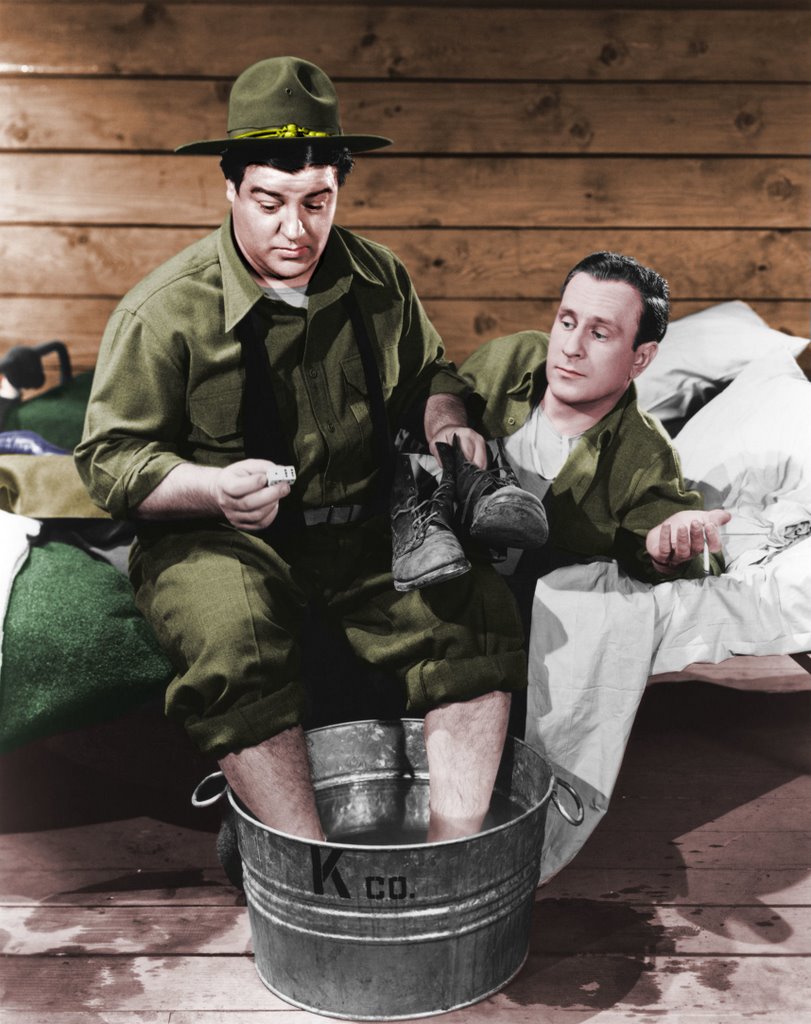
Abbott & Costello and the War on Terror


Is the Bush administration trying to set records for ineptitude? Scotland Yard and MI5 must think so:

A team of suspected terrorists involved in an alleged UK plot to blow up trans-atlantic airliners escaped capture because of interference by the United States, The Independent has been told by counter-terrorism sources.

An investigation by MI5 and Scotland Yard into an alleged plan to smuggle explosive devices on up to 10 passenger jets was jeopardised in August, when the US put pressure on authorities in Pakistan to arrest a suspect allegedly linked to the airliner plot.

As a direct result of the surprise detention of the suspect, British police and MI5 were forced to rush forward plans to arrest an alleged UK gang accused of plotting to destroy the airliners. But a second group of suspected terrorists allegedly linked to the first evaded capture and is still at large, according to security sources.

The escape of the second group is said to be the reason why the UK was kept at its highest level - "critical" - for three days before it was decided that the plotters no longer posed an imminent threat.
Read the full article here.

I wonder if we can get Daniel Craig in a trade for Madonna? Surely, he could tackle the bad guys better than the Bushies.


Senator Barack Obama (D-IL)

Barack Obama's Larger Strategy to Court Hispanic Voters

Rock Star Barack Obama seems surprised that Latinos are upset that he voted for the 700-mile fence along the U.S.-Mexico border.


Obama has met privately with Hispanic leaders in an effort to convince them that his vote is part of a larger strategy.

"It's a done deal, he did it. You know, what am I going to say? Well , I know you made a mistake and we were told it was part of a bigger strategy. What strategy?" [Hispanic leader Carmen] Velasquez said.
"We had to destroy the village in order to save it." Oh, wait, wrong war. Wrong story.

I, too, want to know, what Obama's "larger strategy" is, so I wrote him a long letter this week, asking him to fill me in on the details. I'll let you know what he says as soon as he gets back to me.

Perhaps, Obama didn't realize the powerful symbolic nature of the Fence. Hey, what's a symbol anyway? It's not like the Statue of Liberty holds any powerful meaning for immigrants.

Or, perhaps, Obama is simply courting conservative "Hispanics" who've been here a while and don't like those damn Mexican immigrants messing up their image, rather than courting "Latinos," who probably don't donate much money to presidential campaigns.

Or maybe Barack just doesn't like immigrants, period.

Oh, wait, that's right, his father was an immigrant. Well, the fence shouldn't affect any of his relatives from Kenya.


Senator Hillary Clinton (D-NY)

Hillary Clinton Surprisingly Disliked

[FYI: This is not an actual photograph of Hillary Clinton. It's simply used to illustrate the accompanying article. It is not meant to reflect in any way my personal feelings about the Senator from New York.]

Speaking of Presidential candidates, this article appeared in the Boston Herald back in August. It re-appeared last week on a political blog, though in all the post-Thanksgiving travelling and tryptophan, I can't remember now which one. I've talked with various people about Hillary as a candidate in 2008, and it's interesting how many Liberals dislike her. I wondered if it wasn't just certain people in New York, but this article and its poll numbers suggest otherwise.

Just for the record, she voted for the Fence as well. But I haven't seen any articles about Latinos being upset at her.

HATIN' ON HILLARY; With friends like these: N.H. DEMS lambaste Clinton. By BRETT ARENDS

MANCHESTER, N.H. - Dick Bennett has been polling New Hampshire voters for 30 years. And he's never seen anything like it.

"Lying b**** . . . shrew . . . Machiavellian . . . evil, power-mad witch . . . the ultimate self-serving politician.''

No prizes for guessing which presidential front-runner drew these remarks in focus groups.

But these weren't Republicans talking about Hillary Clinton. They weren't even independents.

These were ordinary, grass-roots DEMOCRATS. People who identified themselves as "likely'' voters in the pivotal state's Democratic primary. And, behind closed doors, this is what nearly half of them are saying.

"I was amazed,'' says Bennett. "I thought there might be some negatives, but I didn't know it would be as strong as this. It's stunning, the similarities between the Republicans and the Democrats, the comments they have about her.''

Bennett runs American Research Group Inc., a highly regarded, independent polling company based in Manchester, N.H. He's been conducting voter surveys there since 1976. The polls are financed by subscribers and corporate sponsors.

He has so far recruited 410 likely voters in the 2008 Democratic primary, and sat down with them privately in small groups to find out what they really think about the candidates and the issues.

His conclusion? `"Forty-five percent of the Democrats are just as negative about her as Republicans are. More Republicans dislike her, but the Democrats dislike her in the same way.''

Hillary's growing brain trust in the party's upper reaches already knows she has high "negatives'' among ordinary Democrats. They think she can win those voters over with the right strategy and message.

But they should get out of D.C., New York and L.A. more often, and visit grassroots members.

Because we're not talking about "soft'' negatives like, say, "out of touch'' or "arrogant.''

We're talking: "Criminal . . . megalomaniac . . . fraud . . . dangerous . . . devil incarnate . . . satanic . . . power freak.''

SATANIC

And: "Political wh***.''

(Note: I don't usually like reporting such personal remarks, but in this case you can hardly understand the situation without them. I have no strong personal feelings about the senator.)

There are caveats. Any survey can be inaccurate or misleading. And 55 percent of ARG's sample was either neutral or positive about Sen. Clinton. Thirty-two percent currently say they plan to vote for her in the primary.

But Bennett says he's never before seen so many N.H. voters show so much hatred toward a member of their own party. He's never even seen anything close.

He believes top national Democrats are missing this grassroots intensity. Instead, he suspects, they are blinded by poll numbers, which give Hillary a big early lead based on her name recognition.

Larry Sabato, director of the University of Virginia's Center for Politics, agrees.

"There is far more anti-Hillary sentiment in the Democratic Party than the pollsters understand,'' he says. In the race for the nomination, "she is ripe for plucking,'' he says.

Sen. Clinton's team could not be reached for comment.

New Hampshire is small, but it's a bellwether state with clout.

Its primary probably holds the key to the Democratic nomination. And New Hampshire, alone, swung from Bush to Kerry in '04.

It's hard to see any Democrat winning the White House without carrying the state in the presidential election. And it's hard, right now, to see Hillary carrying the state.

Sunday, November 05, 2006

News Stories I Haven't Seen in the U.S.

One of the greatest aspects of the internet is the ability we have now to read news from all over the world. There are a number of international news web sites that I check regularly. I just wish I could read more than English, Spanish and a touch of French. How interesting, for example, to read Hindi, Chinese, Arabic or Russian, to see what they're saying about global events. One can get English-language news from most of these areas, and it's interesting, but I always wonder how it compares to the native press. When La Reina and I returned from living in Spain for several years, one of the biggest culture shocks we received was to see how soft and incomplete news coverage had become in the U.S. In the lead-up to the war in Iraq, it became even more clear to me how important it was to get news from around the world. American Journalism reached a nadir, I believe, between 2000 and 2003. While it's gotten somewhat better since then, I still find it lacking.

One web site that particularly impressed me in the lead-up to the war was The Guardian, from the UK. I can't remember now how many important stories I saw there that eventually made it across the Atlantic - after 6 months to a year. They still offer interesting stories that don't get covered here - at least right away. Here are some bits and pieces I found recently that I haven't seen over here:

CIA tried to silence EU on torture flights
Richard Norton-Taylor

According to a secret intelligence report, the CIA offered to let Germany have access to one of its citizens, an al-Qaida suspect being held in a Moroccan cell. But the US secret agents demanded that in return, Berlin should cooperate and "avert pressure from EU" over human rights abuses in the north African country. The report describes Morocco as a "valuable partner in the fight against terrorism".

The classified documents prepared for the German parliament last February make clear that Berlin did eventually get to see the detained suspect . . .

After the CIA offered a deal to Germany, EU countries adopted an almost universal policy of downplaying criticism of human rights records in countries where terrorist suspects have been held. They have also sidestepped questions about secret CIA flights partly because of growing evidence of their complicity.

The disclosure is among fresh revelations about how the CIA flew terrorist suspects to locations where they were tortured, and Britain's knowledge of the practice known as "secret rendition". They are contained in Ghost Plane, by Stephen Grey, the journalist who first revealed details of secret CIA flights in the Guardian a year ago. More than 200 CIA flights have passed through Britain, records show.
So the Bush administration is not only trying to silence U.S. critics of its torture and rendition policies, but it's trying to shut up the Europeans as well. And though the CIA may no longer host annual dinners for New York Times reporters, they obviously have other methods of influencing the press here and abroad.

If we miss this last chance, then our soldiers will have died in vain

Timothy Garton Ash
Nobel prize-winning economist Joseph Stiglitz has estimated that the total, eventual costs of the Iraq war, "including the budgetary, social and macroeconomic costs, are likely to exceed $2 trillion" - that's $2,000,000,000,000. That would be $2,000 a head for each of the world's poorest billion people, who live (and die) on less than $1 a day.
I thought $400,000,000,000 was bad enough, but I've never seen a figure like this in our media. Ash's column is actually in favor of keeping the U.S. and the U.K. in Iraq, but he doesn't pull any punches on how bad things have been up to this point.

Blair-Bush ties hamper Europe, says Schröder
Jess Smee
Former German chancellor Gerhard Schröder has written a damning critique of Tony Blair's special relationship with the United States, saying it hampered Britain's links with Europe.

In his memoirs, Decisions: My Life in Politics, which were launched yesterday, Mr Schröder examines Mr Blair's relationship with George Bush. . . .

"In the foreseeable future, Britain will not give Europe any momentum," he said. "Quite the opposite, the country will continue to protect its role as a transatlantic mediator, even if that is to the cost of the European decision-making process."

He described how signals from Washington that they were "not amused" by a European bid to hammer out its own security policy prompted Britain to swiftly distance itself from the plans.

Both Bill Clinton and Mr Bush found that their national interests were best served by a fragmented Europe, Mr Schröder commented, which gave way to America's "divide and rule" approach to Europe, especially in relation to military, trade and economic affairs.

"But the United States could always count on its special relationship with Britain," he wrote.
I found this interesting because it's the first time I've seen a major European leader discuss an issue that's only going to become more important in time. The creation of the European Union as an economic and political power must lead eventually, it seems, to the development of their own military and a reconsideration of their relationship with the United States. The invasion of Iraq forced a crisis on the EU as most countries were against the war, while a few became part of the Coalition of the Willing. Imagine if California and Kentucky decided to join the Chinese Coalition of the Willing to invade Country X, while the rest of the U.S. seriously opposed the war. You cannot have a successful "kingdom" if it's divided against itself. And I don't think the Eruopeans have spent several decades and gazillions of dollars establishing the EU to have it split apart so easily. Schröder's right to be concerned. What will England do once Blair is out of office? How long will NATO exist as it does now? How will the EU handle another situation like the invasion of Iraq? Will the significant cultural and historical differences between some of the countries in the EU eventually cause it to fall apart? How far will the U.S. (or China?) go to continue its "divide and rule" approach to the EU? England will be the key battleground in this geopolitical struggle. It will be interesting to see what happens over the next 10-20 years.